Beyond epoll: Architecting Ultra-Low Latency Reverse Tunnels with Linux io_uring
Quick answer
Beyond epoll: Architecting Ultra-Low Latency Reverse Tunnels: localhost tunnel answer
A localhost tunnel gives your local app a public HTTPS URL without opening router ports, which is useful for demos, QA, mobile testing, and provider callbacks.
How do I expose localhost without opening ports?
Use a reverse HTTPS tunnel. Your machine connects outbound to the tunnel service, and the public URL forwards requests back to your local app.
When should I use a localhost tunnel?
Use one for webhook testing, OAuth callbacks, client demos, QA previews, mobile device checks, and short-lived development reviews.
For decades, the foundation of high-performance networking on Linux has been undisputed. If you were building a web server, a load balancer, or a reverse proxy designed to handle the infamous C10K (and later C10M) problem, you used epoll. Industry giants like NGINX, HAProxy, and Envoy were built atop this event-driven readiness model, proving its robustness across the globe. However, as we push the boundaries of high-throughput local ingress in 2026, the cracks in the epoll architecture have become glaringly obvious.
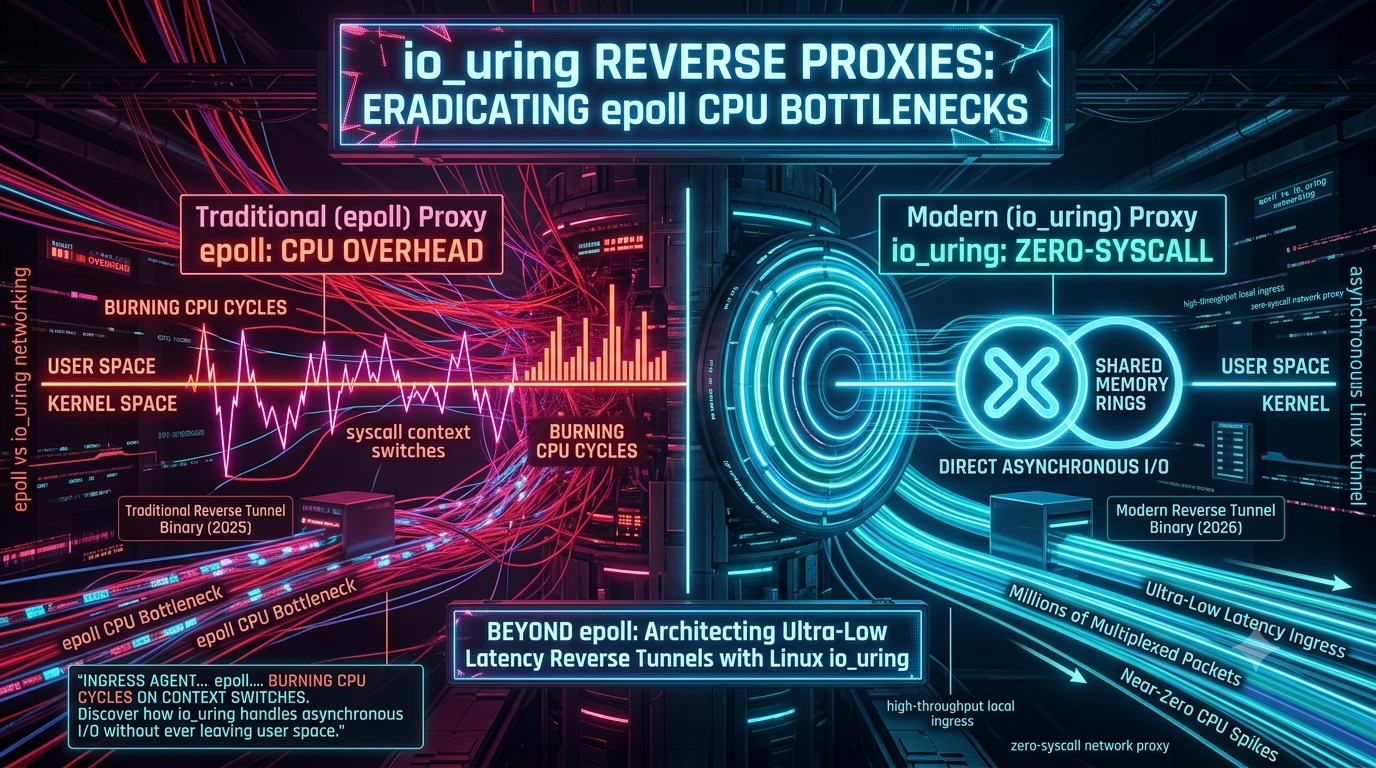
The issue is no longer about managing thousands of connections; it is about the excruciating cost of context switching. When network speeds are measured in hundreds of gigabits per second and latency budgets shrink to single-digit microseconds, the continuous oscillation between user space and kernel space becomes a catastrophic CPU bottleneck.
Enter io_uring, the most significant advancement in Linux I/O in the past decade. By migrating modern tunnel binaries and reverse proxies to this advanced asynchronous I/O API — which leverages shared memory ring buffers — engineers are eradicating syscall overhead on the hot path. This paradigm shift is enabling the creation of ultra-efficient network proxies capable of managing millions of multiplexed packets with near-zero CPU spikes.
This article explores the technical differences between epoll and io_uring networking, detailing how an asynchronous Linux tunnel built on io_uring operates, why the io_uring reverse proxy is fundamentally altering how we design high-throughput local ingress architectures, and what the security and ecosystem tradeoffs look like in 2026.
The Anatomy of the epoll Bottleneck
To understand why an io_uring reverse proxy represents such a meaningful leap, we must first dissect why epoll fails at ultra-high throughputs.
A Quick History
epoll was introduced in Linux kernel 2.5.44 in October 2002 as a scalable replacement for the older select() and poll() system calls. Unlike its predecessors, which operate in O(n) time as the number of watched file descriptors grows, epoll operates in O(1) time for readiness notifications — a critical improvement for high-concurrency servers. It underpinned the entire C10K solution era and powers virtually every high-performance server runtime in production today, including libuv (Node.js), the standard Go network poller, and the event loops inside NGINX and HAProxy.
The Readiness Paradigm
epoll is a readiness notification mechanism. When a reverse proxy manages thousands of client sockets, it uses epoll to ask the kernel: “Which of these file descriptors have data ready to be read, or have buffer space available to be written to?”
The flow of a typical epoll-based proxy looks like this:
- The proxy calls
epoll_wait(), blocking until one or more sockets are ready (context switch: user → kernel → user). - The kernel returns a list of ready file descriptors.
- For each ready socket, the proxy issues a
read()orwrite()system call (context switch: user → kernel → user, again). - If a socket returns
EAGAIN(indicating the operation would block), the proxy stops and waits for the nextepoll_wait()cycle.
The Hidden Costs of Context Switching
While epoll_wait scales much better than its predecessors, the actual I/O operations still require independent system calls. Every read(), write(), accept(), and close() forces a CPU context switch. During a context switch, the CPU must save the user-space register state, flush certain TLB entries, jump to kernel-space execution, validate pointers, perform the operation, and jump back. At 10,000 requests per second, this overhead is negligible. At 1,000,000 packets per second, it dominates the CPU profile. In high-concurrency environments, the proxy can end up spending more CPU time traversing the user–kernel boundary than it does on actual application logic.
Furthermore, epoll strictly separates network I/O from file I/O. Regular files on Linux are always considered “ready” by epoll, yet reads against them can still block on disk. This forces proxy developers to maintain separate thread pools for file I/O alongside their epoll loop, introducing mutex contention, additional memory overhead, and coordination complexity.
Enter io_uring: Asynchronous I/O Redefined
Developed by Jens Axboe while at Facebook (now Meta), io_uring was first merged into the mainline Linux kernel in version 5.1, released in May 2019. It was designed explicitly to address the limitations of the older Linux AIO interface — which only supported direct I/O, suffered from non-deterministic blocking behaviour, and required at least two system calls per I/O operation. The io_uring interface discards the readiness model entirely in favour of a completion model.
Instead of asking the kernel “Is this socket ready?”, an application using io_uring says: “Here is a buffer. Read data from this socket into this buffer, and notify me when you are entirely finished.”
The Shared Memory Rings
The magic of io_uring lies in its namesake: the shared memory rings. When a proxy initialises an io_uring instance via io_uring_setup(), it creates two circular ring buffers mapped into shared memory that is accessible by both user space and the kernel:
- Submission Queue (SQ): The user-space application writes Submission Queue Entries (SQEs) here. An SQE describes an I/O operation: a
readv, awritev, anaccept, a timer, and so on. - Completion Queue (CQ): The kernel writes Completion Queue Entries (CQEs) here. Once an I/O operation finishes, the kernel pushes the result — bytes read/written, or an error code — to the CQ.
Because these queues reside in shared memory, the application can queue many I/O operations without making a single system call. Once the queue is populated, a single io_uring_enter() syscall notifies the kernel to begin processing the batch. The kernel processes the requests asynchronously, writing results directly back to the CQ for the application to consume.
By batching operations, io_uring immediately amortises the cost of system calls across many I/O operations. For a high-performance asynchronous Linux tunnel, this alone is a significant improvement. But io_uring goes much further.
A Unified I/O Model
Unlike epoll, io_uring presents a single unified interface for both network I/O and file I/O. A proxy can submit socket reads, socket writes, sendfile operations, and disk reads all to the same ring, receiving their completions in the same CQ. This eliminates the need for separate thread pools to handle file I/O, dramatically simplifying the architecture of proxies that serve both network streams and local file-based caches.
Architecting the Near-Zero-Syscall Network Proxy
The goal for io_uring proxy architects is the reduction — and on the hot path, near-elimination — of system calls. io_uring makes this possible via a feature flag known as IORING_SETUP_SQPOLL.
SQPOLL: Bypassing io_uring_enter
When an io_uring instance is initialised with IORING_SETUP_SQPOLL, the Linux kernel spawns a dedicated kernel thread specifically for that ring. This thread continuously polls the shared Submission Queue for new entries, rather than waiting to be woken by a io_uring_enter() syscall.
Here is how the proxy operates under SQPOLL:
- The proxy application writes new networking operations (read, write, accept) to the SQ in shared memory.
- The proxy does not call
io_uring_enter(). - The dedicated kernel thread instantly detects the new SQEs and executes the network operations.
- The kernel writes the results to the CQ.
- The proxy application reads the results from the CQ in shared memory.
During the steady-state transmission of data, the proxy process avoids triggering a context switch for each individual I/O operation. The application stays in user space, feeding operations into shared memory and reading results back out. The kernel thread handles the rest.
One important nuance: if the kernel polling thread goes idle after a configurable timeout (set via sq_thread_idle in milliseconds), the application must wake it again via io_uring_enter(). A proxy under continuous load can keep the thread alive indefinitely and avoid this cost entirely.
Privilege requirements have evolved considerably since SQPOLL’s introduction. Early kernels required CAP_SYS_ADMIN. Kernel 5.11 relaxed this to CAP_SYS_NICE. As of kernel 5.13, no special privileges are needed for SQPOLL on modern kernels at all — making it a realistic deployment option outside of containers requiring elevated caps.
Fixed Buffers and Registered Files
To eliminate remaining overhead, modern io_uring proxies use io_uring_register_buffers() and io_uring_register_files(). In traditional epoll proxies, every read() or write() syscall requires the kernel to translate user-space memory pointers and look up file descriptor tables at call time. By registering fixed buffers and files ahead of time, the proxy permanently pins the memory pages and caches the file descriptor mappings in the kernel. When the proxy submits an SQE using a registered buffer index, the kernel bypasses the per-operation lookup overhead, enabling direct DMA paths between the NIC and user-space memory.
Multi-Shot Accept
A particularly powerful feature for reverse proxies is IORING_OP_ACCEPT with the IORING_ACCEPT_MULTISHOT flag, introduced in Linux 5.19. A traditional accept() call — even inside io_uring — requires resubmission after each new connection is accepted. With multi-shot accept, a single SQE continuously generates CQEs for every new incoming connection without needing to be resubmitted. For a high-concurrency ingress proxy handling millions of short-lived connections, this eliminates a whole class of resubmission overhead.
Zero-Copy Networking: The Linux 6.15 Frontier
Perhaps the most significant recent development in io_uring networking landed in Linux 6.15 in 2025: native zero-copy receive (ZC Rx). Prior to this, io_uring had zero-copy transmit support (sending data from user-space buffers to the NIC without kernel copies), but receive still required a kernel-to-user copy step.
The new ZC Rx feature configures a hardware receive queue to DMA incoming packet payloads directly into user-space memory. The kernel processes packet headers through the normal TCP/IP stack, but the payload data never touches kernel memory. “Reading” from a socket effectively becomes a notification mechanism: the kernel tells the application where in user-space memory the data already arrived. In a demonstration using this feature, a 200 Gbit/s link was saturated off a single CPU core.
This advances io_uring-based proxies to a new tier: not just reduced syscall overhead, but a path to true zero-copy receive at the hardware level, with no kernel-bypass complexity of frameworks like DPDK.
The Asynchronous Linux Tunnel in 2026: Rust and Runtime Shifts
The transition to io_uring is not just a kernel API swap; it demands a rethink of the proxy’s internal runtime. epoll relies on readiness, so traditional proxies manage their own memory buffers, handing a pointer to the kernel only at the exact moment a socket is ready. With io_uring, the model shifts to buffer ownership transfer (sometimes called “buffer renting”): because the kernel executes the read or write asynchronously, it must own the memory buffer until the operation completes. If the proxy mutates or drops the buffer while the kernel is still writing to it, memory corruption results.
Thread-Per-Core Runtimes in Rust
To fully harness io_uring, developers of modern tunnel binaries have largely adopted Rust and specialised thread-per-core runtimes. Two prominent options are:
- Monoio (ByteDance / CloudWeGo): A pure
io_uring/epoll/kqueue Rust async runtime with a thread-per-core model. Monoio requires Linux kernel 5.6+ forio_uringsupport and implements buffer renting natively in its I/O abstraction. ByteDance benchmarks show their Monoio-based gateway implementation outperforming NGINX by up to 20% in optimised scenarios, with RPC implementations showing a 26% gain over comparable Tokio-based stacks. - Glommio (originally Datadog): A cooperative thread-per-core runtime for Rust built on
io_uring, requiring kernel 5.8+ and a minimum of 512 KiB of locked memory (RLIMIT_MEMLOCK). Uniquely, Glommio creates three separateio_uringinstances per thread — a main ring, a latency-sensitive ring, and a polling ring — to give finer-grained scheduling control over latency-critical vs. throughput-oriented workloads.
Both enforce a shared-nothing model across CPU cores:
- No work stealing: Each CPU thread has its own isolated
io_uringinstance and manages its own subset of client connections. - Buffer renting: The proxy “rents” ownership of a memory buffer to the runtime. When the network read completes, the runtime returns ownership of the buffer to the application logic.
- Cache locality: Because tasks never migrate between CPU cores, L1 and L2 CPU caches stay hot. There is no mutex contention, no locking overhead, and no cross-thread synchronisation required.
Independent benchmarks of static HTTP file servers comparing io_uring Rust runtimes against standard Tokio find that at a single thread, Monoio achieves roughly 656,000 req/s versus approximately 399,000 req/s for standard Tokio — a ~64% advantage. At four threads, io_uring runtimes collectively exceed 1.1 million req/s, with tokio-uring and Monoio leading the pack. At four threads, io_uring-based runtimes outperform Go’s fasthttp by approximately 2.3×.
In an ingress tunnel scenario — where a local proxy decrypts incoming multiplexed streams (such as HTTP/3 over QUIC) and forwards them to local microservices — this architecture shines. A single ring handles network reads from the outside world, network writes to the local service, and timer events for keepalive, all batched into seamless shared-memory transactions.
The Ecosystem Reality
It is worth being honest about the ecosystem’s maturity. Glommio, originally developed by Glauber Costa at Datadog, has seen reduced active development as its original author moved on and the Datadog team shifted focus. Monoio receives patches and remains functional, but its API surface coverage of newer io_uring features lags somewhat behind the rapidly evolving kernel interface. Apache Iggy, a high-performance message broker, published a detailed account in early 2026 of migrating to a thread-per-core io_uring architecture and encountered real friction: available Rust runtimes don’t fully expose io_uring primitives like request chaining, one-shot receive/send APIs, and registered buffer pools to the degree that C-level liburing users can access them directly.
The ecosystem is maturing, but developers who need the absolute frontier of io_uring’s feature set may find themselves working closer to the liburing C API than they initially expected.
epoll vs io_uring Networking: The Real-World Nuance
Is epoll dead? Absolutely not. For the vast majority of standard web services, APIs, and low-to-moderate traffic applications, epoll remains mature, deeply integrated into existing runtimes, and perfectly adequate. Node.js (libuv) and standard Go use epoll under the hood and handle millions of production workloads daily.
The case for io_uring grows strongest at specific operational thresholds:
- Extremely high request rates where per-syscall overhead becomes a measurable CPU tax.
- Mixed I/O workloads (network + disk) where a unified async model simplifies architecture.
- Tail latency sensitivity where
epoll’s threading model introduces scheduling jitter at p99/p999. - Zero-copy receive paths where NIC hardware and kernel 6.15+ enable direct DMA to user memory.
Red Hat’s developer documentation is appropriately measured on this point: io_uring has been a clear win for file I/O, but for network I/O — which already has non-blocking APIs — gains depend heavily on whether the workload is syscall-bound. Always benchmark under realistic conditions before committing to an architectural rewrite.
Security Considerations: The Double-Edged Interface
No discussion of io_uring in a production context is complete without addressing its security surface. In June 2023, Google’s security team reported that 60% of the exploits submitted to their kernel bug bounty program in 2022 targeted io_uring. Google has paid out approximately $1 million USD in io_uring-related vulnerability rewards. As a result, io_uring was disabled for third-party apps on Android (with SELinux policies limiting access to specific trusted system processes), disabled entirely on ChromeOS, and restricted on Google’s production servers.
Notable CVEs include:
- CVE-2021-41073: Improper memory handling enabling local privilege escalation.
- CVE-2023-2598: Out-of-bounds access enabling LPE.
- CVE-2023-21400: A double-free vulnerability in kernel 5.10, successfully exploited on Google Pixel 7 in a proof-of-concept.
The attack surface stems from io_uring’s complexity and its ability to sidestep conventional monitoring. EDR tools and syscall-based intrusion detection systems that intercept read(), write(), sendmsg(), and recvmsg() are effectively blind to a process operating purely through the ring buffers. Standard tooling like strace produces silence during the active data path — because no syscalls are being made.
For production deployments, the recommended mitigations are:
- Use eBPF-based monitoring tools that instrument kernel-level
io_uringtracepoints rather than relying on syscall interception. - Restrict
io_uringinstance creation via/proc/sys/kernel/io_uring_disabledandio_uring_groupon multi-tenant systems. - Pin deployments to well-patched kernel versions; the 5.15 LTS and 6.x LTS releases have received comprehensive security backports.
- Audit container security policies —
io_uringaccess should be explicitly governed in seccomp profiles.
Overcoming the Challenges of io_uring
Despite its power, architecting an io_uring reverse proxy comes with distinct engineering challenges:
Kernel dependency. io_uring debuted in 5.1, but critical networking features arrived over subsequent releases: multi-shot accept in 5.19, reliable SQPOLL without privileges in 5.13, zero-copy transmit in 5.15, and zero-copy receive in 6.15. Deploying advanced io_uring tunnels on enterprise Linux distributions that ship older kernels (RHEL 8.x ships with kernel 4.18, for example) will result in graceful fallback to epoll or complete feature failure. Kernel version targeting must be explicit.
Memory consumption. Ring buffers and pinned fixed buffers require locked kernel memory (RLIMIT_MEMLOCK). Glommio documents a minimum of 512 KiB per executor thread. At extreme scale with many rings, this requires careful system tuning to avoid OOM issues. Each SQPOLL ring also ties up a dedicated kernel thread, which consumes a CPU core.
Ordering and serialisation. CQEs can arrive in any order, even when SQEs were submitted sequentially (unless explicitly linked with IOSQE_IO_LINK or IOSQE_IO_HARDLINK). On stream-oriented TCP sockets, having more than one outstanding send or more than one outstanding receive without explicit ordering is unsafe, as the kernel may reorder their execution during poll arming. Developers must track request context via user_data pointers attached to every SQE.
Debugging opacity. Standard tools like strace are effectively blind to a zero-syscall proxy on the hot path. Debugging requires bpftrace or custom eBPF programs that tap into io_uring’s internal tracepoints directly to inspect ring state and kernel worker threads. This is a non-trivial operational overhead.
Cancellation safety. Because the kernel owns buffers during async operations, dropping or reusing a buffer before the CQE arrives causes memory corruption. Rust’s ownership model, combined with buffer renting in runtimes like Monoio and Glommio, addresses this at the language level — but only if the application code is structured correctly around those abstractions.
What to Watch in 2026
The io_uring trajectory remains steep:
- PostgreSQL 18 is introducing an optional
io_uringbackend for both data and WAL I/O, with early benchmarks showing a 3× speedup on cold scans over blocking readahead and an 11–15% cumulative gain with registered buffers and SQPOLL enabled. - Zero-copy receive at the NIC level (Linux 6.15) opens the door to proxy architectures where payload data moves directly from the NIC into application memory, skipping kernel buffers entirely on supported hardware.
- Kernel 7.0 (released April 2026) introduced the
IORING_SETUP_NO_SQARRAYmode withIORING_SETUP_LINEAR_SEQNO, a non-circular queue mode designed to keep SQEs hot in L1 cache for small, frequent batch submissions.
Conclusion: A Measured Case for the Shift
The epoll architecture has delivered tremendous value for over two decades and is nowhere near obsolete. But for teams operating at the frontier of high-throughput local ingress — where NVMe arrays deliver millions of IOPS and 400 Gbit/s NICs are a datacenter reality — the per-syscall cost of the readiness model is a measurable bottleneck.
The io_uring kernel API is not a drop-in replacement; it is a fundamental reimagining of how user space and kernel space communicate. Its shared memory rings, buffer renting semantics, SQPOLL mode, and now hardware-level zero-copy receive provide an end-to-end architecture that can extract performance from modern hardware that epoll-based designs cannot match.
The tradeoffs are real: kernel version requirements, a complex and still-evolving security surface, limited strace visibility, and Rust ecosystem runtimes that don’t yet fully expose io_uring’s deepest features. None of these are dealbreakers for a team that plans carefully, targets modern LTS kernels, instruments with eBPF, and profiles under real load before committing to the architecture.
If you are building infrastructure for ultra-high-throughput local ingress, reverse tunneling, or low-latency API gateways, io_uring deserves a serious evaluation. It is not the right choice for every workload. But for the workloads where it fits, the gap between it and epoll is not marginal — it is architectural.
Related InstaTunnel pages
Continue from this article into the most relevant product guides and workflows.
Related Topics
Keep building with InstaTunnel
Read the docs for implementation details or compare plans before you ship.