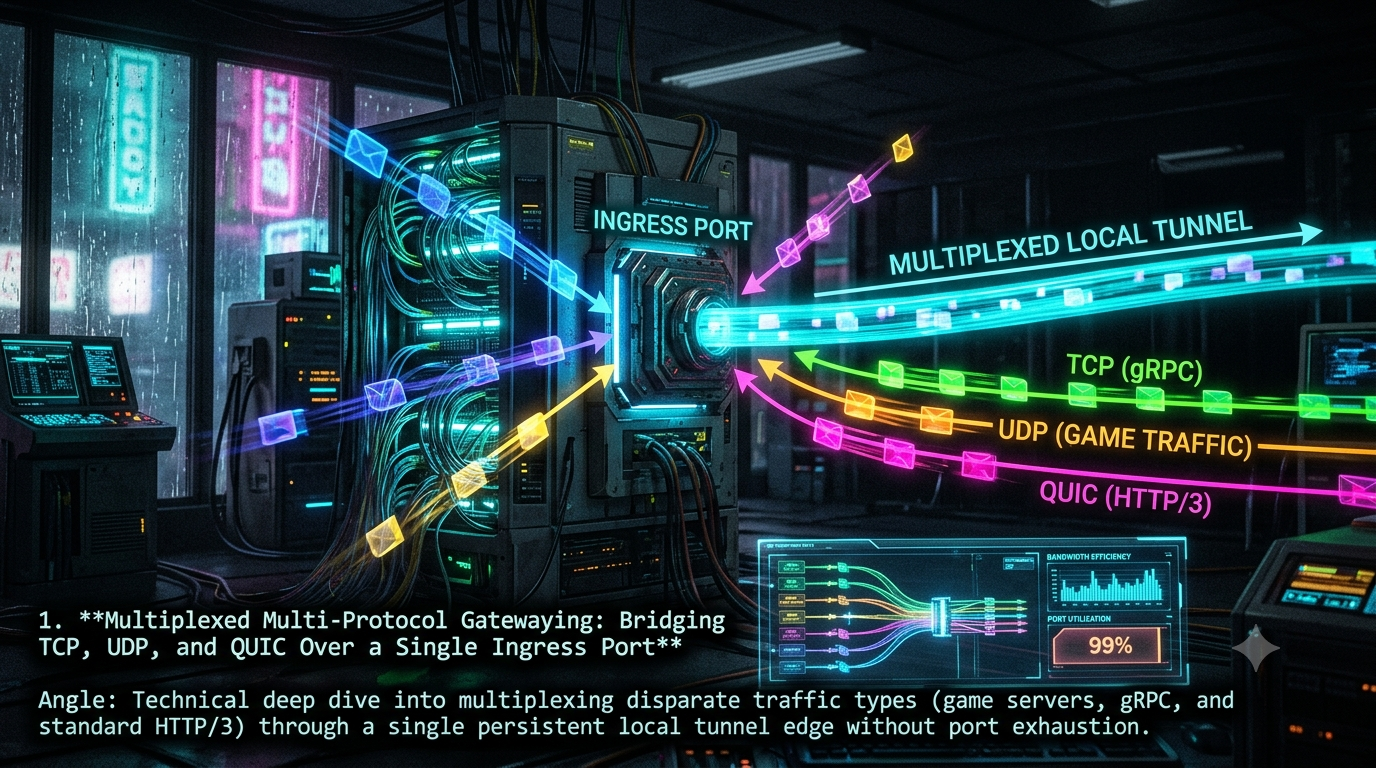
Multiplexed Multi-Protocol Gatewaying: Bridging TCP, UDP, and QUIC Over a Single Ingress Port
Discover how multiplexed multi-protocol gatewaying bridges TCP, UDP, and QUIC over a single ingress port without port exhaustion.
Quick answer
Multiplexed Multi-Protocol Gatewaying: Bridging TCP, UDP: quick comparison answer
Choose the tunnel tool based on the network model: public HTTPS URLs for webhooks and demos, private mesh access for internal apps, and managed infrastructure when policy controls matter most.
Which tunnel tool is best for public webhook testing?
Use a public HTTPS localhost tunnel with stable URLs. InstaTunnel focuses on webhook testing, demos, OAuth callbacks, and MCP endpoint workflows.
When should I choose a private network tool instead?
Choose a private mesh or Zero Trust tool when every user and service should stay inside a controlled private network.
Cloud backends, game servers, and edge networks all want fewer exposed ports. Fewer ports mean simpler firewall rules, fewer load balancers to run, and fewer holes in strict corporate or carrier networks. A single public port such as 443 or 8443 can front gRPC and HTTP/2 over TCP, HTTP/3 over QUIC, and a custom real-time UDP protocol.
The idea is easy to state and easy to get subtly wrong. This guide covers what the operating system gives you for free, how to classify TCP and UDP traffic safely, where eBPF and XDP help, how QUIC connection IDs affect routing, and what really causes port exhaustion. It ends with a small, tested Go gateway you can build on.
1. What “single port” really means
A port number is not one namespace. TCP port 443 and UDP port 443 are separate, so a host can listen on both at once. HTTP/3 already works this way: browsers connect over TCP first, then learn about the HTTP/3 endpoint from an Alt-Svc: h3=":443" response header or an HTTPS DNS record (RFC 9460). Because that endpoint is on UDP 443, clients may need to fall back to TCP if a network filters UDP 443.
So “one port” means one port number, with three problems to solve on top of it:
- Transport split. TCP and UDP are delivered to different sockets by the kernel.
- TCP sub-protocols. TLS (and which application protocol it carries), cleartext HTTP/1.1, cleartext HTTP/2, and custom byte streams all arrive on the same listener.
- UDP sub-protocols. QUIC and your own datagram protocol share one UDP socket, and UDP gives you no handshake to tell them apart.
             ┌───────────────────────────────────────────┐
             │          Public ingress, port 443         │
             └───────────┬─────────────────────┬─────────┘
                         │ TCP                 │ UDP
               ┌─────────▼─────────┐   ┌───────▼────────────────┐
               │ Peek: TLS? PRI?   │   │ First-byte classifier  │
               │ HTTP verb? ALPN?  │   │ (RFC 9443 ranges)      │
               └───┬─────┬─────┬───┘   └──────┬──────────┬──────┘
                   ▼     ▼     ▼              ▼          ▼
                 gRPC  HTTP/1  custom        QUIC /     custom
                 (h2)          TCP           HTTP/3     UDP (game)
Where the 4-tuple stops being enough
When one socket address receives several protocols, the kernel’s lookup (protocol, source address and port, destination address and port) only gets the packet to the right socket. Everything after that is your classifier’s job.
| Transport | What you can inspect | Identifying marker | State |
|---|---|---|---|
| TCP (TLS, HTTP/2, gRPC) | First bytes of the stream | 0x16 = TLS handshake record; ALPN inside the ClientHello |
Kernel connection state |
| TCP (cleartext) | First bytes of the stream | PRI * HTTP/2.0… (HTTP/2 preface) or an HTTP method |
Kernel connection state |
| UDP (QUIC) | First byte of each datagram | High bit set = long header; low-order bits per RFC 9443 ranges | QUIC connection IDs, held by endpoints |
| UDP (custom) | Whatever your protocol defines | Your own first-byte convention | Yours to define |
2. The socket layer: you don’t need SO_REUSEPORT
A common claim is that SO_REUSEPORT is what lets a TCP socket and a UDP socket share a port. It isn’t. Linux tracks TCP and UDP bindings in separate tables, so a TCP listener and a UDP socket can bind 0.0.0.0:443 with no special options.
SO_REUSEPORT solves a different problem: letting several sockets of the same protocol bind the same address and port, with the kernel distributing incoming connections or datagrams among them. By default it hashes on the 4-tuple, and all sockets in the group must belong to the same effective user ID. That is how you scale one listener across many threads or processes.
In Go, the standard library is enough:
ln, _ := net.Listen("tcp", "0.0.0.0:443")        // TCP socket
pc, _ := net.ListenPacket("udp", "0.0.0.0:443")  // UDP socket, same port number
Use SO_REUSEPORT when you want per-core listeners or zero-downtime restarts. Section 5 shows how an eBPF program can override its default hashing.
3. Classifying UDP: QUIC versus your own protocol
This is the hard part. A UDP datagram arrives with no handshake, so the first byte is all you have.
What QUIC guarantees (and what it doesn’t)
RFC 8999 defines only the properties that stay fixed across every QUIC version:
- The most significant bit of the first byte is the header form.
1means long header,0means short header. - Long headers carry a 32-bit Version field (
0x00000000is reserved for Version Negotiation), then length-prefixed Destination and Source Connection IDs. - Short headers carry only the Destination Connection ID, with no length field, so a gateway has to know how long the connection IDs it expects are.
The Fixed Bit (0x40) is not an invariant. RFC 8999 lists “QUIC packets always have the second bit of the first byte (0x40) set” among the incorrect assumptions that can be false for a given version. In QUIC version 1 the bit is set, but RFC 9287 lets endpoints that negotiate the grease_quic_bit transport parameter randomize it.
Likewise, QUIC version 1 requires a minimum size for client Initial datagrams (1200 bytes, RFC 9000 section 14.1), but that is also a version-1 behavior, not an invariant. A short-header packet has no meaningful “minimum 3 bytes” rule you can build a classifier on.
The standard multiplexing scheme: RFC 9443
RFC 9443 (which updates RFC 7983) defines how to demultiplex STUN, ZRTP, DTLS, TURN channels, RTP/RTCP, and QUIC on one UDP socket by looking at the first byte:
| First byte | Protocol |
|---|---|
| 0–3 | STUN |
| 4–15 | Drop |
| 16–19 | ZRTP |
| 20–63 | DTLS |
| 64–79 | TURN channel if the source is a known TURN server, otherwise QUIC |
| 80–127 | QUIC (short header, fixed bit set) |
| 128–191 | RTP / RTCP |
| 192–255 | QUIC (long header, fixed bit set) |
Two consequences matter for a gateway:
- Don’t classify with “long header OR fixed bit set.” That test, common in sketches, matches roughly three quarters of all possible first bytes. Any custom protocol whose first byte lands in
0x40–0xFFwould be misrouted. RFC 9443 itself warns that a misimplemented classifier “could potentially misclassify packets.” - Endpoints behind a multiplexer must not send
grease_quic_bit, because greasing breaks the first-byte scheme (RFC 9443, section 1).
Designing the custom protocol so it can coexist
If you control the game protocol, pick a first byte (a version or message-type field works) that stays in a range QUIC can’t occupy, such as 0–63, or 128–191 if you aren’t also carrying RTP. If you can’t change the protocol, you must accept that first-byte classification is a heuristic, add a stronger check on the long-header path (the Version field is 4 bytes at offset 1, and valid values include 0x00000001 for QUIC v1 and 0x6b3343cf for QUIC v2, RFC 9369), and treat anything ambiguous with care.
A corrected decision procedure
Datagram received
   │
   ▼
byte0 in 64..127 or 192..255 ? ──no──► custom UDP pipeline
   │yes
   ▼
Long header (byte0 & 0x80)?
   ├─ yes ► check Version (v1, v2, or 0 for negotiation) ► QUIC
   └─ no  ► short header: look up the DCID in your connection table
            ├─ hit  ► same backend as the connection
            └─ miss ► drop, or send to QUIC backend (it may issue a stateless reset)
The short-header branch is the catch. A passthrough gateway can only route short-header packets if it either remembers connection IDs (stateful) or the IDs themselves encode the routing decision (see section 5). Without one of those, it can only route by client address, which breaks when a client’s address changes.
4. Classifying TCP: ALPN, prefaces, and Encrypted Client Hello
For TCP, the gateway peeks at the first bytes of the stream without consuming them (recv(..., MSG_PEEK) in C, bufio.Reader.Peek in Go), then forwards everything, including the peeked bytes, to the chosen backend.
| First bytes | Meaning | Route |
|---|---|---|
0x16 + TLS record header |
TLS ClientHello | Parse ALPN (below) |
PRI (PRI * HTTP/2.0\r\n\r\nSM\r\n\r\n) |
Cleartext HTTP/2, “prior knowledge” (h2c), used by gRPC without TLS | HTTP/2 / gRPC backend |
GET , POST, HEAD, … |
Cleartext HTTP/1.1 | HTTP backend |
| anything else | Custom protocol | Fallback backend |
ALPN routing. In TLS 1.3 the ClientHello is unencrypted, and it contains the ALPN extension (type 16) that lists the application protocols the client offers (h2, http/1.1, or custom tokens such as game-v1). The gateway reads the TLS record length from the 5-byte record header, peeks the whole record, walks the extensions, and routes on ALPN without terminating TLS. The Go implementation in section 7 does exactly this and is tested against real crypto/tls ClientHellos.
The ECH caveat. RFC 9849 standardizes Encrypted Client Hello. With ECH, the client encrypts the sensitive ClientHello contents, which protects the SNI and can also protect ALPN, inside an inner ClientHello. The outer ClientHello carries innocuous values. A passthrough gateway therefore only sees what the client chose to expose in the outer hello. As ECH deployment grows, ALPN-based passthrough routing becomes less reliable, and the options are to terminate TLS at the gateway or to route on the outer name. Plan for this rather than assuming ALPN will always be visible.
5. Kernel-level demultiplexing: eBPF, XDP, and socket steering
Peeking in user space costs a system call per decision and gives the kernel no hint about where to deliver. Two eBPF mechanisms address this, and they solve different problems.
Option A: SK_REUSEPORT programs (route to the right socket)
A BPF_PROG_TYPE_SK_REUSEPORT program replaces the default 4-tuple hash when picking a socket from a SO_REUSEPORT group. For UDP, the kernel patch that introduced it describes the use case directly: the program can peek into the datagram payload to learn application-level connection information, then choose the socket from a BPF map. This keeps packets in the normal kernel stack and lets you pin a QUIC connection to a specific worker by connection ID, even if the client’s address changes. Attach it with setsockopt using SO_ATTACH_REUSEPORT_EBPF (it requires CAP_SYS_ADMIN).
Option B: XDP (act before the network stack)
XDP runs at the driver level as soon as the NIC delivers a packet, before the kernel allocates its usual socket buffer. Meta’s open-source Katran layer-4 load balancer is built on this and describes running “right after packet has been received by network interface card … before kernel had any chance to run” in driver mode, with a generic (slower) mode as fallback. XDP can drop, pass, redirect to another interface, or redirect into an AF_XDP socket.
AF_XDP matters for the design, because redirecting into it bypasses the kernel network stack: the packet lands in a user-space memory area, and you are responsible for everything the stack would have done (UDP checksums, ARP, ICMP, socket demultiplexing). The kernel documentation also specifies several behaviors that sketches often get wrong:
- An
XSKMAPis keyed by index, and a redirect only succeeds if the socket at that index is bound to the same device and receive queue the packet arrived on. Otherwise the packet is dropped. - If the map is empty at that index, the packet is dropped too.
- The documented safe pattern is to look up the queue index first and
XDP_PASSif no AF_XDP socket is bound. - If you want only certain traffic in user space, steer it to specific queues with NIC flow rules (the docs show
ethtool -N … action <queue>).
Here is a corrected XDP program that sends only QUIC-range datagrams on UDP port 443 to an AF_XDP socket and lets everything else (TCP, custom UDP, ARP, ICMP) continue through the kernel stack. It compiles with clang -target bpf; I have not load-tested it on a NIC.
#include <linux/bpf.h>
#include <linux/if_ether.h>
#include <linux/in.h>
#include <linux/ip.h>
#include <linux/udp.h>
#include <bpf/bpf_helpers.h>
#include <bpf/bpf_endian.h>

#define INGRESS_PORT 443

struct {
    __uint(type, BPF_MAP_TYPE_XSKMAP);
    __uint(max_entries, 64);
    __type(key, __u32);
    __type(value, __u32);
} xsks_map SEC(".maps");

SEC("xdp")
int xdp_quic_steer(struct xdp_md *ctx)
{
    void *data_end = (void *)(long)ctx->data_end;
    void *data     = (void *)(long)ctx->data;

    struct ethhdr *eth = data;
    if ((void *)(eth + 1) > data_end)
        return XDP_PASS;
    if (eth->h_proto != bpf_htons(ETH_P_IP))
        return XDP_PASS;

    struct iphdr *iph = (void *)(eth + 1);
    if ((void *)(iph + 1) > data_end || iph->protocol != IPPROTO_UDP)
        return XDP_PASS;

    struct udphdr *udph = (void *)iph + iph->ihl * 4;
    if ((void *)(udph + 1) > data_end || udph->dest != bpf_htons(INGRESS_PORT))
        return XDP_PASS;

    unsigned char *payload = (void *)(udph + 1);
    if ((void *)(payload + 1) > data_end)
        return XDP_PASS;

    /* RFC 9443 section 3: first byte 64..127 or 192..255 is QUIC
     * (64..79 is ambiguous only for traffic from a TURN server; not handled). */
    unsigned char b0 = *payload;
    if (!((b0 >= 64 && b0 <= 127) || b0 >= 192))
        return XDP_PASS;                 /* custom UDP: leave it to the kernel stack */

    __u32 q = ctx->rx_queue_index;
    if (bpf_map_lookup_elem(&xsks_map, &q))
        return bpf_redirect_map(&xsks_map, q, 0);
    return XDP_PASS;                     /* no AF_XDP socket on this queue */
}

char _license[] SEC("license") = "GPL";
The program as written handles IPv4 without VLAN tags or IP fragmentation. A production version needs IPv6 and VLAN handling, and a decision about fragments.
Routing QUIC by connection ID across hosts
At scale, the question is how to route short-header packets without per-flow state. Two real approaches exist:
- Server-ID routing. Meta described a stateless scheme at the Linux Plumbers Conference in 2021 where a server ID encoded into the identifiers lets the XDP load balancer route both TCP and QUIC without sharing state.
- QUIC-LB. The QUIC working group’s draft “QUIC-LB: Generating Routable QUIC Connection IDs” defines a standardized way to encode routing information in server-chosen connection IDs. Note its status: as of this writing it is an expired Internet-Draft (latest revision 21, August 2025), not an RFC. It is a design reference, not a standard to claim compliance with.
6. Tunneling several protocols through one edge connection
An edge tunnel (a persistent outbound connection from a private network to a public edge) can carry all three protocol classes over a single session, so the private side needs no inbound ports.
                PUBLIC EDGE (port 443)
   TCP streams ──┐
   QUIC datagrams┼──► classifier ──► tunnel multiplexer ══ one outer session ══►
   UDP datagrams ┘                                                             │
                                                                                ▼
                                          PRIVATE SIDE: demux by channel ► gRPC :50051
                                                                          ► HTTP/3 :9001
                                                                          ► game  :7777
Use the right primitive for each traffic type
- TCP and other byte streams map naturally onto streams (one multiplexed stream per accepted connection). Don’t describe them as “segments”; the tunnel carries a byte stream, not TCP segments.
- UDP and QUIC are datagrams. Pushing them through a single reliable, ordered stream reintroduces head-of-line blocking and retransmission delay that real-time traffic is designed to avoid. Carry them in unreliable datagrams instead. Existing standards cover this: QUIC DATAGRAM frames (RFC 9221), HTTP Datagrams (RFC 9297), and CONNECT-UDP (RFC 9298, “Proxying UDP in HTTP”), which proxies UDP over HTTP/2 or HTTP/3 and can use QUIC datagrams when running over HTTP/3. If you can use one of these, you inherit interoperable framing and proxy support.
- WireGuard is a layer-3 tunnel that carries IP packets over UDP, so it fits as a transport for raw packets, not as a “stream” substrate.
An illustrative custom frame
If you build your own framing, keep it small and explicit. This layout is an example design, not a standard:
 0                   1                   2                   3
 0 1 2 3 4 5 6 7 8 9 0 1 2 3 4 5 6 7 8 9 0 1 2 3 4 5 6 7 8 9 0 1
+-+-+-+-+-+-+-+-+-+-+-+-+-+-+-+-+-+-+-+-+-+-+-+-+-+-+-+-+-+-+-+-+
|  Magic (0xA5) | Protocol Type |           Channel ID          |
+-+-+-+-+-+-+-+-+-+-+-+-+-+-+-+-+-+-+-+-+-+-+-+-+-+-+-+-+-+-+-+-+
|                         Session Token                         |
+-+-+-+-+-+-+-+-+-+-+-+-+-+-+-+-+-+-+-+-+-+-+-+-+-+-+-+-+-+-+-+-+
|        Payload Length         |        Payload Data ...       |
+-+-+-+-+-+-+-+-+-+-+-+-+-+-+-+-+-+-+-+-+-+-+-+-+-+-+-+-+-+-+-+-+
| Field | Size | Purpose |
|---|---|---|
| Magic | 8 bits | Frame-boundary sanity check (0xA5) |
| Protocol Type | 8 bits | 0x01 stream data, 0x02 UDP datagram, 0x03 QUIC datagram |
| Channel ID | 16 bits | Which backend service or tenant |
| Session Token | 32 bits | Per-client identifier for state lookup |
| Payload Length | 16 bits | Up to 65,535 bytes, enough for the largest UDP payload |
A 32-bit token is a lookup key, not a credential. Anything that authenticates a tunnel client must come from a real handshake (TLS, a signed token, or WireGuard keys), never from a guessable counter.
7. Port exhaustion, session state, and what really limits you
“Port exhaustion” gets blamed for many things. Here is what actually applies.
The ephemeral port limit is per destination. On Linux the default outbound range is 32768–60999, about 28,232 ports. A connection is identified by its 4-tuple, so the same source IP and port can be reused for connections to different destinations. The practical limit appears when a gateway opens many connections from one source IP to a single backend IP and port: that tops out near the size of the range.
Mitigations, roughly in order of preference:
- Multiplex instead of one socket per client. Carry many client streams over a few long-lived backend connections (HTTP/2 or your own framing). Cloudflare’s write-up on ephemeral ports makes the same point: long-lived, multiplexed connections beat connection churn.
- Spread across more 4-tuples. Use multiple backend addresses or ports, or multiple source IPs.
- Widen or partition the range. Raise the range via
net.ipv4.ip_local_port_range; newer kernels also offer a per-socketIP_LOCAL_PORT_RANGEoption for carving up the range between components.
Session tables. For connectionless traffic, the gateway needs a table that maps a client (or a connection ID) to its upstream path, with an idle timeout so entries expire. Keep it bounded and reap aggressively; an unbounded table is its own denial-of-service risk.
TUN devices. Injecting raw IP packets through a TUN interface (the clone device is /dev/net/tun; the interface it creates is named something like tun0) forwards at layer 3, so your process allocates no per-client ephemeral ports. That is not the same as “bypassing OS port limits”: if the kernel then performs NAT or masquerading to reach the backend, the NAT still allocates source ports. Use TUN when you can route end to end without NAT.
QUIC connection migration. QUIC separates a connection from the client’s IP and port using connection IDs (RFC 9000, section 5.1). Two details change how a gateway has to behave:
- A migrating client switches to a new connection ID, not the same one on both paths. RFC 9000 requires connection IDs not to be linkable by observers and tells endpoints to limit each ID to one pair of addresses (sections 5.1 and 9.5). A gateway that tracks “this one CID maps to this backend” will therefore lose the connection when the client moves networks.
- A passthrough gateway cannot read the new IDs, because
NEW_CONNECTION_IDframes travel inside encrypted packets. The fix is for the server to issue routable IDs (server-ID routing or QUIC-LB, section 5), or for the gateway to terminate QUIC itself. RFC 9000 section 5.2.3 describes the fallback for simple address-based balancers: servers can send thedisable_active_migrationtransport parameter, or usepreferred_addressto move clients to a dedicated address.
Also note that zero-length connection IDs are fragile behind a shared address: RFC 9000 forbids using one IP and port for multiple concurrent zero-length-CID connections unless migration and NAT rebinding are ruled out.
8. A tested reference gateway in Go
The following program implements the design above using only the standard library:
- It listens on one port number for TCP and UDP.
- For TCP it peeks the first bytes, parses the TLS ClientHello to read ALPN (
h2orhttp/1.1), recognizes the cleartext HTTP/2 preface and HTTP methods, and routes everything else to a fallback backend. Peeked bytes are replayed to the backend. - For UDP it classifies each datagram with the RFC 9443 ranges and keeps one upstream socket per client and backend pair, with idle expiry, relaying replies back through the listening socket.
I compiled it, ran go vet, and tested it against local echo backends. The tests cover plaintext routing (PRI , GET , unknown bytes), UDP routing across the range boundaries (0xC0, 0x45 to QUIC; 0x05, 0x3F, 0x90 to the custom backend), and the ALPN parser against real crypto/tls ClientHellos (h2, http/1.1, an unknown protocol, and no ALPN).
// Single-port TCP+UDP gateway: TCP routed by TLS ALPN / HTTP preface,
// UDP routed by RFC 9443 first-byte ranges. Standard library only.
package main

import (
	"bufio"
	"context"
	"io"
	"log"
	"net"
	"os"
	"os/signal"
	"sync"
	"syscall"
	"time"
)

type Config struct {
	Listen      string
	H2Backend   string // gRPC / HTTP/2
	HTTPBackend string // HTTP/1.1
	TCPFallback string // anything else (custom TCP protocols)
	QUICBackend string // UDP, QUIC / HTTP/3
	GameBackend string // UDP, custom protocol
	UDPIdle     time.Duration
}

func main() {
	cfg := Config{
		Listen: "0.0.0.0:8443", H2Backend: "127.0.0.1:50051", HTTPBackend: "127.0.0.1:8080",
		TCPFallback: "127.0.0.1:9000", QUICBackend: "127.0.0.1:9001", GameBackend: "127.0.0.1:7777",
		UDPIdle: 60 * time.Second,
	}
	ctx, stop := signal.NotifyContext(context.Background(), os.Interrupt, syscall.SIGTERM)
	defer stop()
	go serveTCP(ctx, cfg)
	go serveUDP(ctx, cfg)
	<-ctx.Done()
}

// ---------- TCP ----------

func serveTCP(ctx context.Context, cfg Config) {
	ln, err := net.Listen("tcp", cfg.Listen)
	if err != nil {
		log.Fatalf("tcp listen: %v", err)
	}
	go func() { <-ctx.Done(); ln.Close() }()
	for {
		c, err := ln.Accept()
		if err != nil {
			return
		}
		go handleTCP(c, cfg)
	}
}

func handleTCP(c net.Conn, cfg Config) {
	defer c.Close()
	br := bufio.NewReaderSize(c, 16*1024+5)
	c.SetReadDeadline(time.Now().Add(5 * time.Second)) // sniffing deadline
	backend := cfg.TCPFallback
	if hdr, err := br.Peek(5); err == nil {
		switch {
		case hdr[0] == 0x16: // TLS handshake record
			recLen := int(hdr[3])<<8 | int(hdr[4])
			if rec, err := br.Peek(5 + recLen); err == nil {
				switch alpnPick(rec[5:]) {
				case "h2":
					backend = cfg.H2Backend
				case "http/1.1":
					backend = cfg.HTTPBackend
				}
			}
		case string(hdr[:4]) == "PRI ": // cleartext HTTP/2 prior knowledge
			backend = cfg.H2Backend
		case isHTTPVerb(hdr):
			backend = cfg.HTTPBackend
		}
	}
	c.SetReadDeadline(time.Time{})
	up, err := net.DialTimeout("tcp", backend, 3*time.Second)
	if err != nil {
		log.Printf("dial %s: %v", backend, err)
		return
	}
	defer up.Close()
	var wg sync.WaitGroup
	wg.Add(2)
	go func() { defer wg.Done(); io.Copy(up, br); closeWrite(up) }() // br replays the sniffed bytes
	go func() { defer wg.Done(); io.Copy(c, up); closeWrite(c) }()
	wg.Wait()
}

func closeWrite(c net.Conn) {
	if cw, ok := c.(interface{ CloseWrite() error }); ok {
		cw.CloseWrite()
	}
}

func isHTTPVerb(b []byte) bool {
	for _, v := range []string{"GET ", "POST", "HEAD", "PUT ", "DELE", "OPTI", "PATC"} {
		if string(b[:4]) == v {
			return true
		}
	}
	return false
}

// alpnPick returns the first ALPN protocol the client prefers among h2/http/1.1,
// or "" if the ClientHello has no ALPN extension (or cannot be parsed).
func alpnPick(rec []byte) string {
	p := rec
	adv := func(n int) []byte {
		if len(p) < n {
			p = nil
			return nil
		}
		out := p[:n]
		p = p[n:]
		return out
	}
	if h := adv(4); h == nil || h[0] != 0x01 { // handshake type ClientHello + 3-byte length
		return ""
	}
	adv(2 + 32) // legacy_version + random
	if l := adv(1); l != nil {
		adv(int(l[0])) // session id
	}
	if l := adv(2); l != nil {
		adv(int(l[0])<<8 | int(l[1])) // cipher suites
	}
	if l := adv(1); l != nil {
		adv(int(l[0])) // compression methods
	}
	l := adv(2)
	if l == nil {
		return ""
	}
	exts := adv(int(l[0])<<8 | int(l[1]))
	for len(exts) >= 4 {
		typ := int(exts[0])<<8 | int(exts[1])
		n := int(exts[2])<<8 | int(exts[3])
		if len(exts) < 4+n {
			return ""
		}
		body := exts[4 : 4+n]
		exts = exts[4+n:]
		if typ != 16 || len(body) < 2 { // application_layer_protocol_negotiation
			continue
		}
		list := body[2:]
		for len(list) > 0 {
			k := int(list[0])
			if len(list) < 1+k {
				return ""
			}
			switch s := string(list[1 : 1+k]); s {
			case "h2", "http/1.1":
				return s
			}
			list = list[1+k:]
		}
	}
	return ""
}

// ---------- UDP ----------

// classifyUDP follows RFC 9443 section 3: first byte 80..127 or 192..255 is QUIC;
// 64..79 is QUIC unless it comes from a TURN server (not handled here).
// Keep your own protocol's first byte in 0..63 or 128..191.
func classifyUDP(first byte) (isQUIC bool) {
	return (first >= 64 && first <= 127) || first >= 192
}

type udpSession struct {
	up   *net.UDPConn
	seen time.Time
}

func serveUDP(ctx context.Context, cfg Config) {
	pc, err := net.ListenPacket("udp", cfg.Listen)
	if err != nil {
		log.Fatalf("udp listen: %v", err)
	}
	conn := pc.(*net.UDPConn)
	go func() { <-ctx.Done(); conn.Close() }()

	quicAddr, _ := net.ResolveUDPAddr("udp", cfg.QUICBackend)
	gameAddr, _ := net.ResolveUDPAddr("udp", cfg.GameBackend)

	var mu sync.Mutex
	sessions := map[string]*udpSession{} // key: client addr + backend

	go func() { // idle reaper
		t := time.NewTicker(cfg.UDPIdle / 4)
		defer t.Stop()
		for range t.C {
			mu.Lock()
			for k, s := range sessions {
				if time.Since(s.seen) > cfg.UDPIdle {
					s.up.Close()
					delete(sessions, k)
				}
			}
			mu.Unlock()
		}
	}()

	buf := make([]byte, 65535)
	for {
		n, client, err := conn.ReadFromUDP(buf)
		if err != nil {
			return
		}
		if n == 0 {
			continue
		}
		target := gameAddr
		if classifyUDP(buf[0]) {
			target = quicAddr
		}
		key := client.String() + ">" + target.String()
		mu.Lock()
		s := sessions[key]
		if s == nil {
			up, err := net.DialUDP("udp", nil, target)
			if err != nil {
				mu.Unlock()
				continue
			}
			s = &udpSession{up: up}
			sessions[key] = s
			go func(up *net.UDPConn, client *net.UDPAddr) { // backend -> client
				b := make([]byte, 65535)
				for {
					m, err := up.Read(b)
					if err != nil {
						return
					}
					conn.WriteToUDP(b[:m], client)
				}
			}(up, client)
		}
		s.seen = time.Now()
		mu.Unlock()
		s.up.Write(buf[:n])
	}
}
What this gateway deliberately does not do
It is a foundation, not a finished product. Before exposing it to the internet, plan for the following:
- Client address preservation. Backends see the gateway’s address. Use the PROXY protocol for TCP, or carry the client address in your tunnel framing.
- QUIC connection-ID awareness. Sessions are keyed by client address, so a client that migrates networks gets a new upstream socket. Combine it with server-issued routable connection IDs (section 5) if you need migration to survive.
- One upstream socket per UDP client. That is simple and correct, but each socket uses an ephemeral port, so it inherits the limits in section 7. Cap session counts and consider the multiplexed designs there.
- Abuse controls. There are no rate limits, connection limits, or amplification protection. QUIC servers must limit what they send to an unvalidated address to three times what they received (RFC 9000, section 8), and a gateway that relays replies to spoofed sources can be abused the same way.
- Slowloris-style sniffing. The 5-second sniff deadline bounds idle connections, but you should also cap concurrent unclassified connections.
- Fail-closed behavior. Unknown or malformed first bytes currently fall through to the fallback backend. Decide whether your deployment should drop them instead.
9. Measuring the benefit instead of assuming it
Consolidating ports is mainly an operational win: fewer firewall rules, fewer listeners, one place to enforce policy. Performance gains are workload-specific, so measure before you claim any. Published or invented before-and-after numbers for “single-port versus multi-port” don’t transfer between environments, and the main mechanisms people cite need care:
- Handshake latency. A single port does not shorten a TLS or QUIC handshake, and ALPN is carried inside the ClientHello, so it adds no round trip regardless of port count. QUIC 0-RTT applies only to resumed connections, and RFC 9000 warns it provides no protection against replay attacks, so it is not a general latency win and not safe for non-idempotent requests.
- Per-packet cost. User-space classification costs a system call or two per datagram. Kernel-side classification (
SK_REUSEPORTor XDP) removes that cost for the traffic it handles. Batched reads (recvmmsg, and UDP GRO and GSO on supporting kernels) cut it further without eBPF. XDP with AF_XDP trades kernel-stack features for speed, so it pays off at high packet rates, not at typical game-server loads. - What to measure. Track connection setup time at p50/p99, packets per second per core at a fixed loss target, CPU per Gbit/s, sockets and ephemeral ports in use (
ss -s), and drops at each stage (NIC, socket buffers, your session table). Test with your real client mix, including QUIC clients that migrate and clients behind carrier NAT.
10. Implementation checklist
- Sockets. Bind TCP and UDP to the same port number with ordinary listeners; add
SO_REUSEPORTonly for per-core scaling of one protocol. - UDP classification. Use the RFC 9443 first-byte ranges, never “long header or fixed bit.” Keep your own protocol’s first byte out of the QUIC ranges, and don’t enable
grease_quic_biton endpoints behind a first-byte multiplexer. - QUIC routing. Decide up front how short-header packets find their backend: server-issued routable connection IDs (server-ID routing, QUIC-LB), a connection table, or terminating QUIC at the gateway. Without one of these, migration breaks.
- TCP classification. Peek, don’t consume; parse ALPN from the ClientHello; handle the
PRIpreface and HTTP methods; have a plan for ECH. - Kernel acceleration. Reach for
SK_REUSEPORTeBPF first (it keeps the normal stack); use XDP and AF_XDP only when you need driver-level speed and can own the user-space stack. - Tunnels. Carry streams as streams and datagrams as datagrams (RFC 9221, RFC 9297, RFC 9298), and authenticate tunnel clients properly.
- Port budgets. Count ephemeral ports per backend 4-tuple, not per host, and multiplex before you widen ranges.
- Hardening. Bound every table, time out every session, rate-limit unvalidated UDP sources, and decide what happens to traffic you can’t classify.
References
- RFC 8999: Version-Independent Properties of QUIC
- RFC 9000: QUIC: A UDP-Based Multiplexed and Secure Transport
- RFC 9443: Multiplexing Scheme Updates for QUIC
- RFC 9849: TLS Encrypted Client Hello
- RFC 9298: Proxying UDP in HTTP
- AF_XDP, The Linux Kernel documentation
- BPF_PROG_TYPE_SK_REUSEPORT, eBPF documentation
- QUIC-LB: Generating Routable QUIC Connection IDs (Internet-Draft)
- Katran, Meta’s XDP-based layer 4 load balancer
- From XDP to Socket, Linux Plumbers Conference 2021
- Cloudflare: How to stop running out of ephemeral ports
- Peakhour: How browsers decide to use HTTP/3
Related InstaTunnel pages
Continue from this article into the most relevant product guides and workflows.
Related Topics
Keep building with InstaTunnel
Read the docs for implementation details or compare plans before you ship.