Seamless Roaming: Building Nomadic Localhost Tunnels with QUIC Connection Migration
Quick answer
Seamless Roaming: Building Nomadic Localhost Tunnels with QU: localhost tunnel answer
A localhost tunnel gives your local app a public HTTPS URL without opening router ports, which is useful for demos, QA, mobile testing, and provider callbacks.
How do I expose localhost without opening ports?
Use a reverse HTTPS tunnel. Your machine connects outbound to the tunnel service, and the public URL forwards requests back to your local app.
When should I use a localhost tunnel?
Use one for webhook testing, OAuth callbacks, client demos, QA previews, mobile device checks, and short-lived development reviews.
In the modern development ecosystem, the concept of a stationary workstation bound to a single office network is obsolete. Today’s engineers are inherently nomadic. A typical coding session might begin on a home fiber connection, seamlessly transition to a 5G cellular hotspot during a commute, and conclude on a public Wi-Fi network at a coffee shop.
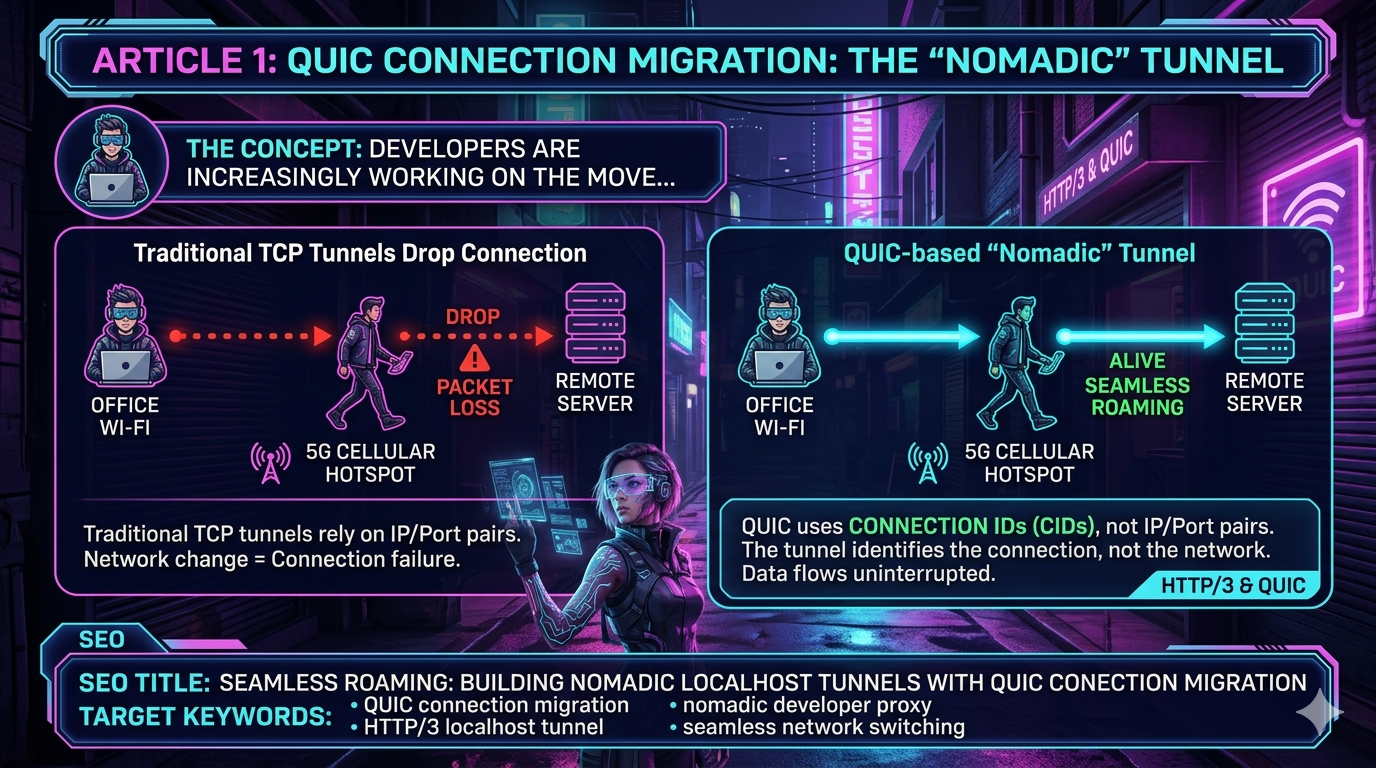
However, while our hardware and workflows have embraced this mobility, the foundational networking protocols underlying our developer tools have historically fought against it. If you have ever run a traditional localhost tunnel, an SSH proxy, or a classic TCP-based VPN, you know the frustration: the moment your laptop switches from Wi-Fi to cellular, your active connections freeze, your terminal hangs, and your webhooks drop. You are forced to manually restart your local proxy agent and wait for a new session to establish.
This friction is the result of decades-old transport layer design. But a fundamental shift is happening in how we expose local development environments to the public internet. By leveraging HTTP/3 and the QUIC protocol, a new generation of “nomadic” localhost tunnels has emerged — tools that utilize a feature known as QUIC Connection Migration to keep tunnels perfectly alive, without dropping a single packet, even as the underlying network hardware and IP addresses completely change.
The “TCP Tax” and the Brittleness of Traditional Tunnels
To appreciate the elegance of QUIC connection migration, we must first understand why standard tools fail so predictably when you move between networks.
For decades, the Transmission Control Protocol (TCP) has been the undisputed king of reliable internet transport. Almost all legacy tunneling solutions — including classic OpenVPN, SSH tunnels, and older iterations of reverse proxies like ngrok — rely on TCP to guarantee that packets arrive in order and without corruption.
In the TCP paradigm, a connection is strictly defined by a 4-tuple:
- Source IP Address
- Source Port
- Destination IP Address
- Destination Port
This 4-tuple is baked into the operating system’s network stack at the kernel level. It acts as the absolute identifier for the session. If any of these four variables change, the TCP state machine dictates that the connection is no longer valid.
When you walk out of your house, your laptop disconnects from your home router and connects to your phone’s 5G hotspot. Instantly, your machine is assigned a new IP address by your cellular carrier’s NAT (Network Address Translation). The Source IP in the 4-tuple changes. From the perspective of the server hosting your localhost tunnel endpoint, the original TCP connection has simply gone silent. When packets arrive from your new 5G IP, the server has no idea they belong to the previous session, and it drops them.
The application layer — your developer proxy client — must then detect the broken pipe, terminate the old socket, perform a completely new DNS lookup, execute a new 3-way TCP handshake, and negotiate a fresh TLS 1.3 cryptographic handshake. This process introduces significant latency and, more critically, interrupts any ongoing data transfers, API requests, or active webhooks hitting your local environment.
Head-of-Line Blocking: The Double Penalty
Even without physically switching networks, TCP-based tunnels suffer on mobile and edge networks due to Head-of-Line (HOL) blocking. If a transient network glitch causes a single packet to drop, TCP halts the delivery of all subsequent, successfully received packets to the application layer until the missing packet is retransmitted and acknowledged. In a multiplexed tunnel where HTTP requests, SSH traffic, and database queries are all jammed into a single TCP stream, one lost packet stalls the entire pipeline.
HTTP/2 introduced multiplexing at the application layer to tackle this problem — but it only moved the bottleneck downward. TCP is an ordered byte stream, and when any packet is lost, every HTTP/2 stream on that connection stalls until retransmission arrives. In high-packet-loss environments, the brute-force approach of opening multiple TCP connections with HTTP/1.1 actually beats HTTP/2’s single connection. That’s an embarrassing irony the protocol community spent years acknowledging.
The HTTP/3 and QUIC Revolution
Enter QUIC and HTTP/3. Originally developed by Google (first deployed internally around 2012) and standardized by the IETF as RFC 9000 in May 2021 (with HTTP/3 following as RFC 9114 in June 2022), QUIC was designed from the ground up to solve the mobility and performance bottlenecks of TCP.
Adoption has been rapid and is now undeniable. As of October 2025, HTTP/3 accounts for approximately 35% of global web traffic according to Cloudflare data, and over 35% of monitored websites advertise HTTP/3 support via Alt-Svc or DNS as of April 2026. Meta routes roughly 75% of its traffic over QUIC/HTTP/3, and over 50% of YouTube traffic globally is delivered over QUIC. All major browsers — Chrome, Firefox, Safari, and Edge — have supported it since 2021–2022. Server support has matured too: Nginx added stable HTTP/3 in version 1.27.4 (February 2025), and Caddy enables it by default.
QUIC operates in user space and runs on top of UDP. Unlike TCP, UDP is connectionless — it fires packets at a destination without worrying about handshakes or state. QUIC takes this lightweight transport and builds its own highly optimized, connection-oriented state machine on top of it, entirely in user space, bypassing the rigid rules of the OS kernel.
Furthermore, QUIC fundamentally integrates TLS 1.3 into its core. Cryptographic negotiation happens concurrently with connection establishment, enabling 0-RTT (Zero Round Trip Time) handshakes for known servers — reducing connection setup time by 100 to 300 ms compared to TCP+TLS on typical mobile networks, and improving Time to First Byte (TTFB) by 5 to 20 percent compared to HTTP/2.
But the true magic — the feature that makes nomadic tunnels possible — lies in how QUIC identifies a connection.
Unpacking QUIC Connection Migration
QUIC completely abandons the IP-based 4-tuple for connection identification. Instead, it relies on abstract, cryptographic identifiers known as Connection IDs (CIDs).
When a QUIC client (your nomadic developer proxy) initiates a connection to a QUIC server (the edge relay), they negotiate a set of unique Connection IDs. These IDs are embedded in the short header of every single QUIC packet sent over the wire. Because the connection state is tied to this logical Connection ID rather than the physical IP address, the network path becomes entirely modular.
The Seamless Network Switching Workflow
Here is exactly what happens at the packet level when a developer using a QUIC-based HTTP/3 localhost tunnel switches from Wi-Fi to a 5G cellular network:
1. The Initial State. The developer is sitting in an office. Their proxy client is communicating with the edge server via the office Wi-Fi IP. Traffic is flowing securely, identified by Connection ID: A.
2. The Transition. The developer leaves the building. The Wi-Fi signal drops. The laptop automatically fails over to a paired 5G cellular tether and is assigned a completely new IPv4/IPv6 address from the mobile carrier.
3. Path Probing. The QUIC proxy client detects the change in its local routing table. Instead of tearing down the tunnel, it immediately sends a Path Challenge frame to the server from its new IP address. This packet still carries Connection ID: A (or a newly rotated, pre-negotiated ID linked to the same session).
4. Path Validation. The server receives the Path Challenge from the unfamiliar IP. Because the packet carries a valid Connection ID and is properly encrypted with the session’s TLS keys, the server recognizes the exact same client. It responds with a Path Response to the new IP address.
5. Seamless Migration. Once the new path is validated — a process taking only milliseconds — the connection fully migrates. Stream states, TLS encryption keys, the congestion window, and the multiplexed data channels are perfectly preserved.
To the application layer — whether it’s an Express.js server on localhost:3000, a live WebSocket feed, or a webhook dispatcher — nothing happened. The network hardware underneath was entirely swapped out, but not a single connection was dropped, and not a single byte of data was lost.
The Modern Tooling Landscape
The tunneling ecosystem has matured significantly. Developers are rapidly abandoning legacy SSH remote port forwarding (ssh -R) and older TCP tunneling agents in favor of modern HTTP/3 stacks. The 2026 toolkit looks like this:
Cloudflare Tunnel (cloudflared)
Cloudflare Tunnel takes an infrastructure-oriented approach. Rather than temporary developer links, it integrates directly with Cloudflare’s global network and security platform, routing traffic through outbound connections to Cloudflare’s edge. It’s completely free with no bandwidth caps, making it a go-to for production-grade access to private services without opening inbound ports. The main limitation is that it does not support raw TCP or UDP tunnels.
ngrok
Still the most recognized tool for a reason — polished developer experience, powerful traffic inspection, and replay features. However, in 2026 the free tier comes with random URLs that change on every restart, bandwidth and request limits, and no UDP support. Paid plans start at $8/month. Useful when you specifically need the interactive request inspector.
Pinggy and localhost.run
Both let you start a tunnel with a single SSH command — no installation required. Ideal for quick one-off sharing when you can’t install anything on the machine.
Open-Source Self-Hosted: frp, bore, chisel, zrok
frp (Fast Reverse Proxy) leads with over 100,000 GitHub stars and supports HTTP/HTTPS, TCP, and UDP. chisel works through restrictive firewalls using WebSockets. bore keeps things minimal for basic TCP tunneling. zrok focuses on zero-trust networking for those who want full self-hosted control.
Rust-Native QUIC Libraries
For teams building their own tunneling infrastructure, two battle-tested Rust libraries dominate:
quinn— A pure-Rust QUIC implementation with over 86 million total downloads on crates.io and a straightforward async/await API compatible with Tokio. Widely used in production services across the Rust ecosystem.s2n-quic— AWS’s open-source Rust implementation of RFC 9000, integrating with eithers2n-tlsorrustlsfor the TLS 1.3 handshake. Offers configurable congestion control (CUBIC), packet pacing, Path MTU discovery, and unique connection identifiers decoupled from the address — making it natively suited for connection migration. Licensed under Apache 2.0.
Key Architectural Features of a QUIC-Native Tunnel
Multiplexed Independent Streams
When exposing multiple local services — say, a React frontend on port 3000 and a Python API on port 8000 — a QUIC tunnel handles them as mathematically independent streams within the same Connection ID. If a packet destined for the frontend is lost during a network handover, it does not block the API traffic. Each QUIC stream handles packet loss independently, fully eliminating the head-of-line blocking that cripples TCP tunnels on unstable mobile networks.
Proactive Connection ID Rotation
To prevent ISPs or passive observers from tracking a developer’s physical movement across networks (a property known as linkability), nomadic tunnels use QUIC’s built-in CID rotation. The client and server securely exchange a list of future Connection IDs during the initial handshake. When the developer switches from Wi-Fi to 5G, the client not only changes its IP but also seamlessly rotates to a new CID. The new traffic flow looks entirely unrelated to passive observers, while the server stitches the session together internally.
BBR Congestion Control
Mobile networks are notorious for high jitter and sudden bandwidth fluctuations. QUIC implementations increasingly favor BBR (Bottleneck Bandwidth and Round-trip propagation time) over the traditional loss-based CUBIC algorithm. Rather than blindly cutting throughput in half on a packet drop — as CUBIC does — BBR models the actual network capacity through active measurement. Emerging variants like BBRv2 improve fairness and reduce loss in contested networks. When returning from a micro-dropout during a network switch, BBR allows a tunnel to ramp back up to maximum speed almost immediately.
Real-World Use Cases
Live Mobile App Development and API Polling
Mobile developers testing iOS or Android applications on physical devices while commuting can tunnel the local backend API over a nomadic QUIC connection. The physical phone switches between Wi-Fi and 5G cellular data without the API suddenly returning 502 Bad Gateway errors. Long-polling requests and Server-Sent Events (SSE) remain perfectly stable across the transition.
Webhook Testing over Satellite Internet
With the proliferation of LEO (Low Earth Orbit) satellite internet like Starlink and Amazon Kuiper, developers increasingly work off-grid. Satellite networks inherently experience “micro-dropouts” every few minutes as the dish physically hands over its connection from one fast-moving satellite to another. For a standard TCP proxy, this causes massive latency spikes and connection resets. A QUIC-based nomadic tunnel treats the satellite handover exactly like a Wi-Fi-to-5G switch — migrating seamlessly and maintaining stable webhook receivers for platforms like Stripe or GitHub without missing a single payload.
Stateful Microservice Mobility at the Edge
Beyond individual developer laptops, this technology is beginning to influence container orchestration at the edge. With server-side QUIC connection migration, orchestrators can physically migrate a live, stateful microservice container from one datacenter to another — changing its IP address in the process — without dropping the active connections of the clients consuming that service. This is an active area of deployment and research in Kubernetes edge environments.
Navigating the Edge-Case Challenges
UDP Throttling and Corporate Firewalls
Because QUIC runs on UDP, it occasionally runs into enterprise firewalls designed in the 2010s that blindly throttle or block high-volume UDP traffic — often misidentifying it as DDoS amplification or unauthorized BitTorrent activity. Modern nomadic proxies handle this through rapid fallback: if the initial QUIC UDP handshake is blocked, the tunnel agent fails over to a standard TCP/TLS 1.3 connection via port 443, sacrificing seamless mobility to ensure the connection at least succeeds.
It’s worth noting an ongoing ecosystem challenge: most QUIC implementations are built on BoringSSL forks rather than mainline OpenSSL. OpenSSL’s incompatible QUIC API approach (server support arriving in OpenSSL 3.5 in 2025) has created a schism that complicates broad server-side adoption, particularly for organizations standardized on mainstream OpenSSL distributions.
Stateful NAT Timeouts
On mobile carrier networks utilizing Carrier-Grade NAT (CGNAT), UDP port mappings can expire quickly if no traffic is flowing. If a developer’s laptop goes idle on a 5G connection, the carrier’s NAT might silently drop the routing table entry. Nomadic tunnels combat this with aggressive, low-bandwidth HTTP/3 PING frames that keep the NAT state actively mapped, ensuring the tunnel is always ready to receive incoming webhooks even after long idle periods.
Deployment Debugging
Validating that traffic is actually riding QUIC rather than silently falling back to HTTP/2 requires deliberate tooling. Chrome DevTools’ Network panel shows a Protocol column where h3 confirms HTTP/3. For packet-level analysis, Wireshark supports QUIC capture but requires a TLS key log file to decrypt the payload. curl offers --http3-only for strict QUIC testing and --http3 for upgrade testing with automatic fallback. A browser silently falling back to HTTP/2 is not a sign of a healthy site — it often indicates a broken UDP path, a misconfigured Alt-Svc header, or a certificate issue that the browser is quietly working around.
Conclusion: The Future is Transport-Agnostic
The era of binding software stability to physical network topology is coming to an end. The integration of QUIC connection migration into developer tooling represents a fundamental decoupling of the application layer from the transport layer.
By utilizing Connection IDs rather than brittle IP/Port tuples, and by shifting network logic into user space, nomadic localhost tunnels have finally aligned our digital infrastructure with the physical reality of how we work. Whether you are coding on a bullet train, switching between access points in a large office, or tethering to a phone in a remote cabin, your development environment no longer cares about your IP address.
HTTP/3 is not a future technology — it’s present tense. Over a third of the web runs it today. The tools are mature, the libraries are production-ready, and the deployment cost has never been lower. Nginx needs two extra lines of config. Caddy enables it by default.
Building a robust, seamless, high-performance nomadic workflow means abandoning the TCP tax. It means embracing HTTP/3, deploying resilient UDP-based agents, and ensuring that when your network inevitably changes, your tunnel doesn’t even blink.
Sources: IETF RFC 9000 (QUIC), RFC 9114 (HTTP/3), Cloudflare Radar 2024 Year in Review, InspectWP QUIC reference (May 2026), DEV Community HTTP/3 adoption analysis (March 2026), AWS s2n-quic documentation, quinn crates.io (86M+ downloads), Pinggy tunnel alternatives guide (2026), FreeCodeCamp ngrok alternatives guide (March 2026).
Related InstaTunnel pages
Continue from this article into the most relevant product guides and workflows.
Related Topics
Keep building with InstaTunnel
Read the docs for implementation details or compare plans before you ship.