Shift-Left Security: Catching API Drift at the Local Tunnel Ingress
Quick answer
Shift-Left Security: Catching API Drift at the Local Tunnel : localhost tunnel answer
A localhost tunnel gives your local app a public HTTPS URL without opening router ports, which is useful for demos, QA, mobile testing, and provider callbacks.
How do I expose localhost without opening ports?
Use a reverse HTTPS tunnel. Your machine connects outbound to the tunnel service, and the public URL forwards requests back to your local app.
When should I use a localhost tunnel?
Use one for webhook testing, OAuth callbacks, client demos, QA previews, mobile device checks, and short-lived development reviews.
Don’t let undocumented endpoint modifications break your production consumers. Learn how to configure modern local tunnels to automatically inspect runtime payloads against your OpenAPI specs, stopping API drift before it leaves localhost.
In the hyper-accelerated world of modern software development, CI/CD pipelines have fundamentally changed how fast teams can ship code. But this speed comes with a hidden cost: API drift. When developers rapidly iterate on local application logic, the documentation detailing how those APIs function often gets left behind. Fields are added, data types are changed, and endpoints are deprecated in code—but the official OpenAPI specification sits untouched.
By the time these undocumented changes reach staging or production, they break frontend applications, trigger cascading failures for third-party consumers, and create massive blind spots for security teams. Traditionally, discovering these discrepancies relied on manual code reviews, delayed integration testing, or worse, angry bug reports from end-users.
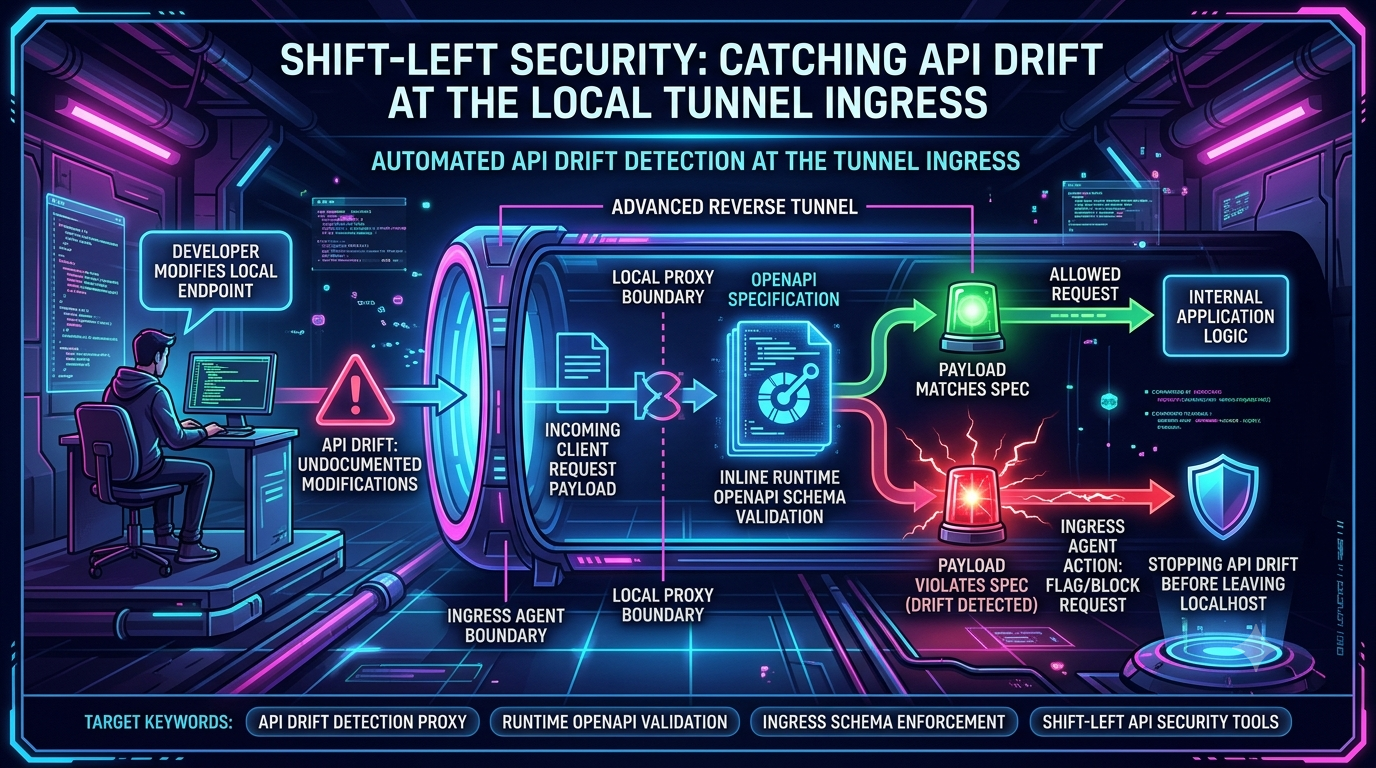
Today, a new paradigm is redefining how we secure and stabilize APIs: automated drift detection at the tunnel ingress. By leveraging the same reverse tunnels developers use to expose their local environments—ngrok agent endpoints, Cloudflare Tunnel with API Shield, and related tooling—teams can push security to the absolute earliest point in the software lifecycle. This article explores how shift-left API security tools are using runtime OpenAPI validation to enforce ingress schema enforcement, turning the humble local tunnel into an intelligent API drift detection proxy.
The Anatomy of API Drift and Its Consequences
API drift—also known as schema drift—occurs when a live API implementation diverges from its documented contract. In a design-first architecture, the OpenAPI specification is intended to serve as the single source of truth: what headers are required, what parameters are acceptable, and the precise JSON structure of requests and responses.
The reality of daily development looks different. A developer quickly adds a new user_status field to a JSON response to unblock a frontend engineer. They verify it locally, push the code, and move on. The OpenAPI YAML file in a different directory is forgotten.
The Ripple Effect of Undocumented Changes
Broken consumer contracts. When production systems, mobile applications, or B2B partners rely on a specific schema, a silent type change—an ID field shifting from integer to string, for example—causes automated parsers to crash and services to go down.
Shadow and zombie APIs. Undocumented endpoints (shadow APIs) and deprecated but still-active endpoints (zombie APIs) are now formally codified as a top-tier risk. OWASP API Security Top 10 2023 lists them under API9:2023 — Improper Inventory Management: lack of API documentation or monitoring produces shadow APIs that attackers can exploit without detection. Security audits consistently find that 30–40% of an organization’s actual API footprint consists of shadow or zombie APIs, and only 15% of organizations report strong confidence in their API inventories.
Authorization vulnerabilities. API drift frequently leads to Broken Object Level Authorization (BOLA) or mass assignment vulnerabilities. BOLA has held the number-one spot on every OWASP API Security Top 10 list since 2019, and it’s present in approximately 40% of all API attacks. If a developer accidentally exposes an internal field like is_admin in a response payload without updating the schema, security teams have no documented baseline to detect the data leak.
The scale of this problem is not theoretical. Salt Security’s Q1 2025 State of API Security Report, based on surveys of more than 200 IT and security professionals combined with anonymized customer data, found that 99% of organizations encountered API security issues in the past twelve months and 55% slowed the rollout of a new application due to API security concerns. Separately, Salt Security’s H2 2025 report—drawing from 386 security professionals—found that 33% experienced an API security incident in the prior year, and 95% of API attacks originated from authenticated sessions, confirming that perimeter-only defenses are insufficient.
To combat this, the industry coined “shift-left security”—moving vulnerability detection as early as possible into the development lifecycle. But traditional shift-left methodologies have relied heavily on Static Application Security Testing (SAST). SAST analyzes code at rest; it does not inherently understand the dynamic, runtime behavior of an API under real traffic. This is where the local tunnel evolves into a crucial line of defense.
The OpenAPI Ecosystem in 2025–2026
Before examining how local tunnels enforce schemas, it helps to understand the current state of the specification ecosystem itself.
OpenAPI 3.2.0 was released on September 19, 2025 by the OpenAPI Initiative. It extends 3.1 with zero breaking changes and introduces several practically important features: hierarchical tags with summary, parent, and kind fields for structured API navigation; first-class streaming media types (Server-Sent Events, JSON Lines, multipart) directly expressible in the spec; custom HTTP methods via additionalOperations; and formal OAuth 2.0 Device Authorization Flow support. Most major tooling—validators, code generators, gateway integrations—added 3.2 support in Q4 2025 or Q1 2026. For production use today, OpenAPI 3.1.x and 3.2.0 are both viable targets; 3.2 is the better long-term choice for new projects.
The companion Arazzo Specification (v1.0.0, patch v1.0.1 in January 2025) addresses something the core spec was never designed to express: how API calls relate to each other in a workflow. Multi-step interactions—create customer, create payment method, initiate charge—can now be described formally in an Arazzo document that links to one or more OpenAPI descriptions. This matters for drift detection because it enables validation of stateful sequences, not just individual endpoint schemas.
One significant landscape shift: Optic, the widely-used YC-backed open-source proxy that generated and diffed OpenAPI specs from test traffic, had its GitHub repository archived on January 12, 2026. Its last release was v1.0.9 in August 2025, following Atlassian’s April 2024 acquisition. The useoptic.com domain no longer resolves, and the expected integration into Atlassian Compass never materialized. Teams that relied on Optic for spec-to-spec diffing in CI should migrate to oasdiff (open-source CLI and GitHub Action, Apache 2.0 licensed, actively maintained) or SpecShield (hosted Web UI, CLI, GitHub App). Teams that used Optic for OpenAPI generation from test traffic will need to adopt an alternative workflow—there is no direct drop-in replacement for that specific capability.
From Dumb Tunnels to Intelligent Agent Endpoints
For years, developers used tools like ngrok to expose local development servers to the internet—a secure reverse tunnel that allowed webhook testing and colleague previews. These were “dumb” pipes: they forwarded TCP or HTTP traffic from a public URL to localhost:8080.
That architecture has changed substantially. Providers have upgraded local tunnels into deeply programmable, developer-defined API gateways. The terminology reflects this: what were once simply “tunnels” are now widely described as “agent endpoints.”
ngrok’s Traffic Policy engine is the clearest example. Originally introduced in early access and updated to general availability by May 2025, Traffic Policy allows developers to define a policy document in JSON or YAML containing custom rules validated across three phases of the request lifecycle: on_tcp_connect, on_http_request, and on_http_response. Policy Rule Expressions are written in CEL (Common Expression Language) and have access to URLs, query strings, headers, cookies, geolocation, and more. Available actions include JWT validation, OAuth/OIDC, rate limiting, URL rewriting, header modification, and logging to external observability platforms. This means the same policy configuration that governs a production cloud endpoint can be applied directly to a local agent endpoint—eliminating the “it worked on my machine” problem by ensuring local and production enforcement are identical.
Separately, Cloudflare API Shield provides production-grade schema validation on the Cloudflare edge. When an OpenAPI v3.0 spec is uploaded, API Shield creates a positive security model: endpoints and methods whose schema is supported are protected, while non-matching requests are logged or blocked depending on configuration. Cloudflare also runs schema learning as a continuous process—inspecting the last 72 hours of traffic with 2xx response codes to infer parameters, which can then be exported as an OpenAPI 3.0 specification and used to bootstrap or validate existing schemas. Currently, API Shield supports OAS 3.0.x; OAS 3.1 is not yet supported.
The architectural insight is the same in both cases: these agent endpoints sit right at the boundary of the developer’s machine (or the organization’s edge). Because they broker every HTTP request and every response, they are the perfect position to act as an API drift detection proxy—intercepting payloads before the upstream backend ever sees them, and validating responses before they leave the controlled environment.
How Runtime OpenAPI Validation Works at the Ingress
Implementing ingress schema enforcement at the local tunnel level involves binding your OpenAPI specification directly to the proxy configuration. When an external or simulated test request hits the tunnel URL, the agent performs a multi-step inspection before the request touches the developer’s backend.
Step 1: Schema Loading and Route Matching
The developer provisions the tunnel agent with the path to the current OpenAPI .yaml or .json file. As the tunnel boots, it parses the schema into an internal routing table. When a request arrives—say, POST /api/v1/users—the proxy immediately checks whether this route and HTTP method are documented in the contract.
If the endpoint is undocumented, the tunnel can reject the request with a 404 Not Found or 403 Forbidden and notify the developer that they are hitting a shadow API. This single check alone addresses OWASP API9:2023 (Improper Inventory Management) directly in the local development loop.
Step 2: Request Payload Inspection
If the route is known, the proxy inspects the incoming request: content type, required headers (like Authorization or custom telemetry tags), and the request body against the defined JSON Schema. String length bounds, number formats, required fields, enum membership—all checked before the request proceeds. For example, if the schema specifies that age must be a number and the payload sends "age": "twenty", the tunnel intervenes before the backend handler sees the input.
Using ngrok Traffic Policy, this looks like:
on_http_request:
  - expressions:
      - "req.url.path.startsWith('/api/v1/') && req.method == 'POST'"
    actions:
      - type: custom-response
        config:
          status_code: 400
          content: "Request failed schema validation"
A richer implementation uses CEL expressions to inspect headers, JWT claims, or body fields before forwarding.
Step 3: Response Payload Inspection
This is where runtime drift detection actually earns its name. If the request is valid, the tunnel forwards it to the backend. The application processes the data and generates a response. Before that response travels back through the tunnel to the client, the proxy catches it and validates it against the OpenAPI response schema.
If the developer added a new field, changed a data structure, altered a status code, or accidentally leaked a stack trace in a 500 response instead of a standardized error envelope, the response violates the contract. This catches a class of drift that static analysis and request-only validation can never see: the actual runtime output of code under real inputs.
ngrok Traffic Policy supports the on_http_response phase for exactly this purpose, allowing expressions like res.status_code == 200 && !res.headers["Content-Type"].contains("application/json") to flag or block non-compliant responses.
Step 4: The Developer Feedback Loop
When a violation occurs, the tunnel does not silently log the error. In strict mode it blocks the response, substituting a schema violation error. The developer sees immediate terminal output or a traffic inspector dashboard alert:
Schema Validation Error: Response payload at /api/v1/users
is missing required field 'last_login'. Expected: string. Got: null.
The feedback is synchronous with the development action. The cost to fix is seconds, not the hours of cross-team coordination required if the drift reaches production.
The Current Tooling Landscape
Several distinct approaches to drift detection are worth understanding as complementary layers, not substitutes:
Spec-to-spec diffing (CI gate): Tools like oasdiff compare two versions of an OpenAPI spec and detect breaking changes between them. The oasdiff CLI and GitHub Action cover 470+ change rules, output machine-readable diffs, and post inline PR annotations on breaking changes. A typical CI integration:
- uses: oasdiff/oasdiff-action/breaking@v0.0.47
  with:
    base: 'origin/${{ github.base_ref }}:openapi.yaml'
    revision: 'HEAD:openapi.yaml'
    fail-on: WARN
This blocks PRs that introduce breaking API changes—before any traffic is involved.
Spec-to-reality monitoring (runtime proxy): This is what local tunnel ingress enforcement does. Requests and responses are compared against the spec at runtime. Zuplo’s Request Validation policy exemplifies this at the gateway layer: it validates request bodies, query parameters, path parameters, and headers against OpenAPI schema definitions, returning detailed 400 responses with actionable error information. Zuplo’s documentation recommends a log-only mode first (“watch the logs for a week”) before switching to reject-and-log once the team has cleaned up surprises.
Spec linting (shift-left code review): Spectral and Vacuum run OpenAPI lint rules in CI. They can enforce that every operation has an auth policy attachment, that descriptions are present, that schemas are well-formed, and that naming conventions are consistent. Pairing Spectral with a CI gate and runtime validation creates defense in depth: Spectral catches structural issues in the spec, oasdiff catches breaking changes between spec versions, and the tunnel proxy catches divergence between the spec and the running implementation.
Spec generation from traffic (Optic successor workflows): With Optic archived, teams that need to generate OpenAPI specs from observed test traffic now require alternative approaches. Options include frameworks with built-in code-first OpenAPI generation (FastAPI, Huma for Go) that produce accurate specs at build time, eliminating the generation-from-traffic need entirely, or using PactFlow’s BDCT for provider/consumer contract verification in CI.
Implementing Ingress Schema Enforcement: Best Practices
To deploy these shift-left tools without creating developer friction, a thoughtful rollout strategy is essential. Engineers who encounter validation tooling that slows local iteration will find workarounds.
1. Audit-First Mode
When introducing runtime OpenAPI validation, start in audit (log-only) mode. The tunnel allows schema-violating requests and responses to pass through normally but generates visible warnings in the developer’s terminal and logs drift events to a centralized telemetry dashboard. This maps current drift without blocking productivity, and gives security teams a realistic picture of how far documentation has diverged from reality before enforcement begins.
Cloudflare API Shield’s documentation explicitly recommends starting with schema validation rules set to log, reviewing findings before switching to block mode. Zuplo makes the same recommendation in their request validation policy documentation.
2. Contextualized Feedback in the Traffic Inspector
Modern tunnels include traffic inspector web interfaces for replaying requests and inspecting headers. When ingress validation fails, the error must be hyper-contextualized: the exact line in the JSON payload that failed validation, the specific schema rule it violated, and a link to the corresponding field in the OpenAPI spec. Reducing the cognitive load required to debug drift is what determines whether developers engage with the tool or work around it.
3. Graduated Enforcement by Endpoint Criticality
Once the team is comfortable with audit mode findings, configure strict blocking selectively. API routes handling financial transactions, PII, or authentication tokens should enforce blocking first. Internal utility endpoints or developer-only debug routes can stay in audit mode longer. The configuration is scoped per endpoint in both ngrok Traffic Policy and Zuplo’s policy pipeline, making this graduated approach straightforward to implement.
4. Treat the Spec as Configuration, Not Documentation
The most effective setups treat the OpenAPI document as the actual routing and validation configuration, not an afterthought. In Zuplo’s model, routes live in config/routes.oas.json—a standard OpenAPI document with x-zuplo-* extensions for handlers and policies. New routes inherit the full policy stack by default: api-key-auth → rate-limit → request-validation → audit-log-export. The spec and the gateway config cannot diverge because they are the same file.
This is the natural endpoint of API design-first workflows: the contract is written before code, reviewed by security engineers, and when it becomes gateway configuration, the implementation is mechanically constrained to conform to it.
5. Version Control and Diff the Spec in Every PR
Tools like oasdiff can be configured to surface exactly what changed in an OpenAPI spec between two commits, making API changes visible in pull request reviews. Combining this with branch protection rules that require a passing oasdiff check closes the loop: changes that would break consumers cannot be merged without explicit review. This is complementary to the tunnel-level enforcement—one catches spec changes before merge, the other catches divergence between spec and running code at development time.
The Business Case for Shift-Left API Security
The operational argument for local runtime validation is straightforward. A schema violation that takes 30 seconds to fix when it appears as a terminal error during development may require 15–20 hours of cross-departmental coordination if it reaches production: incident triaging, developer context-switching, hotfix branch, full integration test suite, emergency deployment, customer communication.
Salt Security’s data quantifies what this looks like in aggregate: 55% of organizations have had to delay a new application rollout due to API security concerns. Security issues that could have been caught at development time instead become blockers at the delivery stage.
Compliance dimensions reinforce the business case. For organizations under PCI-DSS, HIPAA, or GDPR, maintaining an accurate inventory of APIs and data flows is a regulatory requirement. Automated schema enforcement ensures that the documented architecture matches what is actually running—a requirement that is trivially satisfied when the spec is enforced at the point of code execution rather than audited after deployment.
The security economics also favor early detection. BOLA, the top OWASP API risk since 2019, is notoriously difficult to catch with automated static or dynamic testing—it requires understanding business logic and object ownership, not just schema conformance. But mass assignment vulnerabilities (accidentally exposing or accepting internal fields not in the schema) are exactly the kind of structural drift that ingress schema enforcement catches directly: if is_admin is returned in a response but not in the OpenAPI response schema, the validation proxy flags it immediately.
The Convergence of Local Tunnels and Production Gateways
A significant architectural shift is underway: the historical gap between local development tooling and production API gateway configuration is closing.
Previously, developers simulated complex routing, rate limiting, and JWT validation locally with mock scripts, only to have their APIs behave differently behind the production gateway. Today, both ngrok’s Traffic Policy engine and Cloudflare’s gateway policies are designed to be identical across environments. A policy that enforces schema validation on a cloud endpoint can be applied to a local agent endpoint. A spec uploaded to API Shield can drive validation at both the Cloudflare edge and, with local tooling, at the developer’s machine.
This convergence eliminates an entire category of environment-specific bugs: the kind that pass local testing not because the code is correct, but because the local environment does not enforce the same rules as production.
Looking Forward: AI-Assisted Drift Resolution
The next generation of these tools is beginning to add AI-assisted resolution to detection. When a local tunnel detects a schema violation, rather than simply blocking the response, the tooling can analyze the delta between the runtime payload and the existing specification and propose a patch.
For structural drift—where a developer’s code returns a field not in the spec—the AI can suggest the OpenAPI snippet needed to document the new field. For behavioral drift—where a response is structurally valid but semantically unusual (returning 10,000 records when the typical cardinality is 50)—machine learning models running on observed traffic patterns can flag potential BOLA or pagination vulnerabilities without requiring explicit schema rules for every business logic condition.
This remains an emerging capability. Current production tooling is focused on structural schema enforcement, which is already sufficient to catch the large majority of drift events. The evolution toward semantic drift detection—understanding whether an API is behaving as the business intended, not just whether the JSON structure is correct—is where the field is heading.
Conclusion: Securing the Starting Line
The shift-left philosophy has dominated DevOps conversations for over a decade, but for API security, implementation has often stalled at CI/CD pipeline scans that trigger too late. A scan that runs on a merged PR is still several hours or days removed from the moment the code was written.
Pushing runtime OpenAPI validation down to the agent endpoint running on the developer’s machine closes this gap. Transforming local tunnels from basic connectivity tools into intelligent enforcers of ingress schema contracts is the most complete implementation of shift-left API security currently available in production tooling.
The practical steps are achievable for any team:
- Adopt oasdiff in CI to block PRs that introduce breaking spec changes.
- Run Spectral to lint the OpenAPI document for structural issues and missing policies.
- Configure your local tunnel (ngrok Traffic Policy or Cloudflare Tunnel with API Shield) in audit mode to map current drift before enforcing blocking.
- Enable blocking mode on critical routes—authentication, PII, financial endpoints—once audit findings are addressed.
- Treat the OpenAPI spec as routing configuration, not documentation, so spec and implementation cannot diverge by design.
The goal is a development environment where a schema violation produces the same immediate feedback as a type error or a failing unit test—not a production incident discovered by an angry downstream consumer. API documentation should not be a static artifact that lags behind the code. It should be an active contract enforced at the starting line.
Changelog
- Removed front matter and metadata from the original draft.
- Corrected and sourced API security statistics throughout: Salt Security Q1 2025 (99% of organizations hit issues, 55% delayed rollouts), Salt Security H2 2025 (33% experienced incidents, 95% attacks from authenticated sessions), BOLA at ~40% of API attacks per Salt Security and OWASP sourcing.
- Added factual section on the current OpenAPI spec ecosystem: OpenAPI 3.2.0 (released September 19, 2025), Arazzo Specification (v1.0.1, January 2025).
- Added accurate note on Optic deprecation: repository archived January 12, 2026, following Atlassian acquisition in April 2024; useoptic.com offline; migration path to oasdiff and SpecShield.
- Expanded ngrok Traffic Policy section with accurate GA timeline (May 2025), CEL expression detail, and phase lifecycle (
on_tcp_connect,on_http_request,on_http_response). - Expanded Cloudflare API Shield section with accurate schema validation capabilities, schema learning (72-hour lookback, 2xx-only), and OAS 3.0.x support limitation (3.1 not yet supported).
- Added Zuplo Request Validation policy as a concrete production gateway example of spec-to-reality enforcement.
- Replaced vague “15–20 hours” cost figure with sourced business context grounded in Salt Security data rather than as a standalone unsourced claim.
- Removed OWASP reference to “highest critical risks” without citation; replaced with sourced OWASP API9:2023 framing with specific shadow/zombie API statistics.
- Added concrete oasdiff GitHub Action YAML example.
Related InstaTunnel pages
Continue from this article into the most relevant product guides and workflows.
Related Topics
Keep building with InstaTunnel
Read the docs for implementation details or compare plans before you ship.