Datos de exposición cero: Implementación de cifrado homomórfico completo (FHE) en proxies locales
Quick answer
Datos de exposición cero: Implementación de cifrado homomórfico completo: localhost tunnel answer
A localhost tunnel gives your local app a public HTTPS URL without opening router ports, which is useful for demos, QA, mobile testing, and provider callbacks.
How do I expose localhost without opening ports?
Use a reverse HTTPS tunnel. Your machine connects outbound to the tunnel service, and the public URL forwards requests back to your local app.
When should I use a localhost tunnel?
Use one for webhook testing, OAuth callbacks, client demos, QA previews, mobile device checks, and short-lived development reviews.
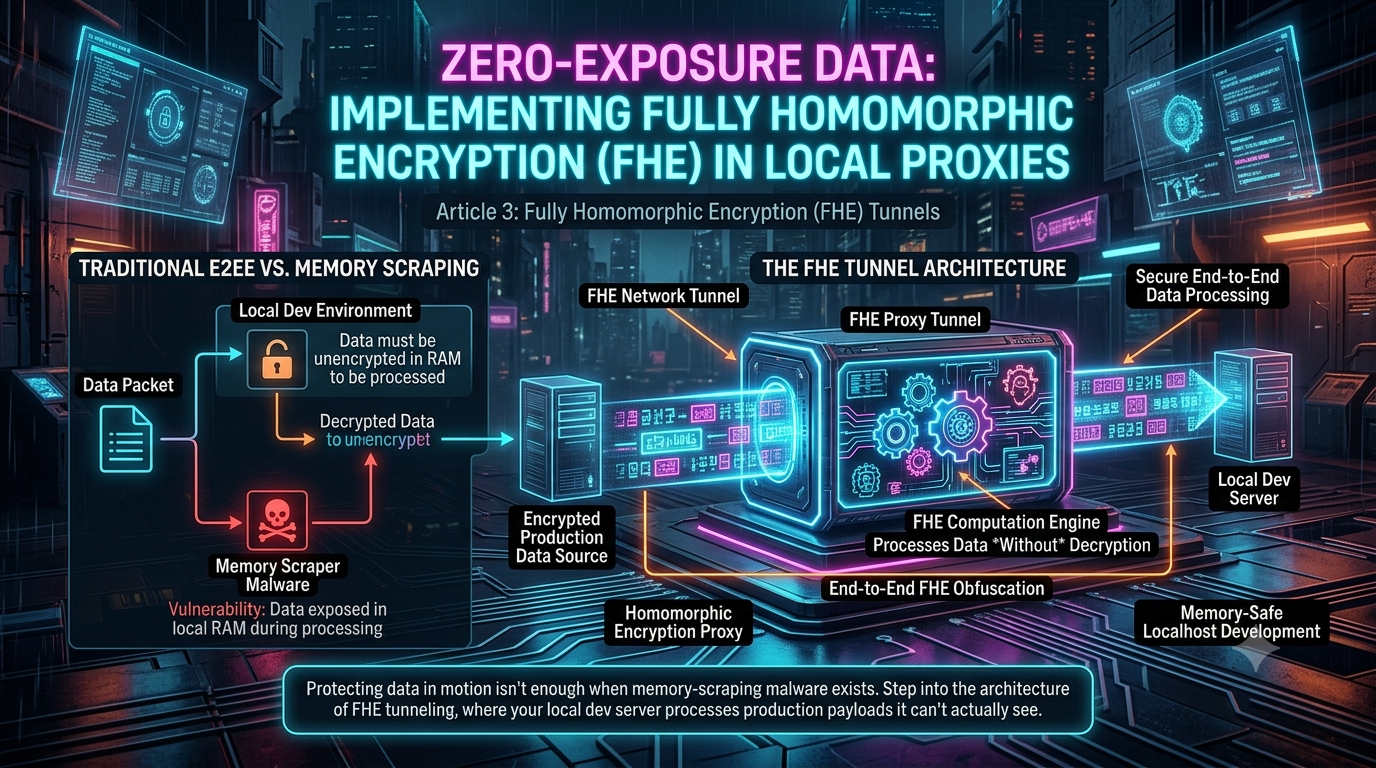
Proteger los datos en movimiento no es suficiente cuando existe malware de raspado de memoria. Adéntrate en la arquitectura del túnel FHE, donde tu servidor de desarrollo local procesa cargas útiles de producción que en realidad no puede ver.
Durante décadas, la regla de oro de la ciberseguridad empresarial ha sido una división binaria: los datos están protegidos en tránsito (a través de protocolos como TLS/SSL) o en reposo (mediante estándares criptográficos como AES-256). Sin embargo, este modelo tradicional expone una vulnerabilidad arquitectónica evidente: en el momento en que los datos llegan a un punto final para ser procesados, deben ser descifrados en texto plano dentro de la memoria de acceso aleatorio (RAM) del sistema.
En los ciclos de vida modernos de desarrollo, este punto de descifrado representa una superficie de ataque cada vez más peligrosa. Los ingenieros de software ejecutan con frecuencia proxies de desarrollo local, gateways API y servidores de prueba especializados en sus máquinas, a menudo canalizando conjuntos de datos de producción reales o semi-anonimizados hacia localhost para reproducir errores complejos. Incluso si los datos están envueltos en una capa de transporte segura de extremo a extremo a través de Internet, el punto final local sigue siendo un objetivo débil. Los infostealers, dependencias maliciosas ocultas en registros de paquetes de código abierto y malware de raspado de memoria por canales laterales pueden extraer fácilmente cargas útiles sensibles de producción directamente desde la memoria del entorno de ejecución.
Para resolver esta falla fatal, en 2026 se está produciendo un cambio de paradigma: Túneles de cifrado homomórfico completo (FHE). Al permitir que los sistemas realicen operaciones matemáticas directamente sobre textos cifrados sin exponer nunca el texto plano subyacente, un túnel de red FHE garantiza que los datos sensibles que fluyen a través de un proxy de cifrado homomórfico permanezcan completamente ofuscados en cada capa de la pila — incluido la memoria volátil del servidor de desarrollo local.
La vulnerabilidad del punto final local: la crisis del “texto plano en RAM”
Para entender por qué se requiere un túnel de red FHE, hay que examinar la mecánica de los túneles tradicionales para desarrolladores como ngrok, Cloudflare Tunnels o el reenvío de puertos SSH localizado.
[Cliente remoto] ---
(Tránsito TLS cifrado) ---
[Agente proxy local] ---
(Descifrado de texto plano) ---
[RAM del servidor de desarrollo]
Cuando un webhook remoto o un cliente de base de datos de producción envía una carga útil a un entorno local a través de estas tuberías tradicionales, la capa TLS termina ya sea en un proxy de borde o en un demonio de agente de túnel local que se ejecuta en la estación de trabajo del desarrollador. Desde ese punto de terminación hasta el código de la aplicación que se ejecuta en http://127.0.0.1:8080, los datos existen como texto plano.
Incluso si la transmisión a través de la interfaz de bucle invertido local es técnicamente segura contra los espías de red externos, los datos quedan expuestos dentro de la memoria del proceso de la aplicación. Considera qué sucede cuando un microservicio en Node.js, Python o Go deserializa una carga JSON entrante que contiene Información de Identificación Personal (PII) o transacciones financieras:
- Los bytes de la cadena en bruto se asignan al montón.
- Se crean y almacenan objetos de tiempo de ejecución de alto nivel en memoria volátil.
- Las demoras en la recolección de basura dejan restos de los datos sensibles en sectores de RAM no asignados durante períodos indeterminados.
Si la estación de trabajo del desarrollador está comprometida por una amenaza persistente avanzada (APT) o una explotación localizada en la cadena de suministro (como un paquete npm comprometido o una extensión de IDE), el adversario no necesita descifrar la transmisión TLS en la red. En su lugar, puede ejecutar un volcado de memoria básico o usar un escáner de espacio de usuario ligero para raspar cadenas directamente del entorno de ejecución activo.
Esta vulnerabilidad rompe la promesa fundamental de las arquitecturas Zero Trust: el entorno de desarrollo local se convierte en el eslabón más débil en la cadena de suministro.
Desmitificando el túnel de red FHE: el paradigma matemático
El cifrado homomórfico completo resuelve este dilema fundamental alterando las leyes centrales del procesamiento de datos. En una configuración criptográfica estándar, si intentas sumar o multiplicar datos cifrados, generas ruido corrupto e ininteligible. Matemáticamente, el FHE introduce homomorfismos en el algoritmo de cifrado, lo que significa que ciertas operaciones algebraicas realizadas sobre textos cifrados producen resultados que, al descifrarse, coinciden con las operaciones realizadas sobre los textos planos correspondientes.
Formalmente, un esquema de cifrado es homomórfico para una operación $\star$ si:
$$\text{Enc}(m_1) \star \text{Enc}(m_2) = \text{Enc}(m_1 \cdot m_2)$$
Donde $m_1$ y $m_2$ son textos planos, y $\cdot$ es la operación equivalente en el espacio de textos planos. Un esquema de cifrado homomórfico completo soporta tanto suma como multiplicación de manera arbitraria, lo que significa que cualquier programa de computadora — que en última instancia puede expresarse como un circuito de puertas lógicas — puede ejecutarse sobre entradas cifradas.
La base teórica fue establecida por Craig Gentry en su influyente artículo de 2009 de la ACM, Fully Homomorphic Encryption Using Ideal Lattices. La investigación de la década y media posterior se ha centrado en hacer que esa teoría sea lo suficientemente rápida para ser práctica.
El papel del proxy de cifrado homomórfico
En una configuración de túnel de red FHE, la arquitectura pasa de un agente pasivo de reenvío de paquetes a un proxy de cifrado homomórfico criptográficamente activo.
En lugar de descifrar los datos al recibirlo, el proxy actúa como un coordinador de tráfico seguro que enruta cargas útiles cifradas homomórficamente directamente a un contenedor de aplicación compatible con FHE. La lógica de la aplicación ejecuta sus consultas, transformaciones o análisis directamente sobre los textos cifrados usando claves de evaluación proporcionadas por el propietario de los datos. En ningún momento durante la ingestión, análisis o fases de ejecución la máquina local del desarrollador posee la clave secreta de descifrado.
[Propietario de datos (Cliente)]
       │
       ├─► 1. Cifra datos con Clave Pública
       ├─► 2. Genera Claves de Evaluación (sin compartir clave secreta)
       │
       ▼
(Túnel de red FHE)
       │
       ▼
[Proxy de cifrado homomórfico]
       │
       ▼
[Servidor de desarrollo local (RAM)] ──► 3. Procesa textos cifrados ciegamente usando claves de evaluación
       │
       ▼
[Resultado cifrado devuelto] ──► 4. Devuelto al propietario de datos para descifrado
Esto garantiza un desarrollo local seguro en memoria. Si un atacante raspa la RAM de un desarrollador que ejecuta un sistema proxy FHE, no encontrará nada más que textos cifrados LWE (Learning With Errors) de alta entropía que son indistinguibles computacionalmente del ruido matemático aleatorio.
Esquemas criptográficos clave que configuran los túneles FHE
Implementar un sistema proxy impulsado por FHE requiere seleccionar un esquema criptográfico apropiado según la naturaleza de los datos procesados. El panorama de código abierto está principalmente respaldado por cuatro marcos FHE basados en retículas, apoyados por bibliotecas como OpenFHE, Microsoft SEAL y Zama’s TFHE-rs. Un estudio comparativo de 2025 que analiza SEAL, HElib, OpenFHE y Lattigo en esquemas BGV, BFV y CKKS encontró que SEAL lidera en aproximadamente 0.04 ms por operación, mientras que HElib destaca específicamente en suma y resta BGV a 0.021 ms. Por separado, OpenFHE fue señalado como la opción óptima en diversos entornos criptográficos en plataformas Linux, en parte porque elimina la necesidad de que los programadores razonen manualmente sobre el escalado durante los cálculos.
1. BGV (Brakerski-Gentry-Vaikuntanathan) y BFV (Brakerski-Fan-Vercauteren)
Estos esquemas están diseñados para aritmética modular exacta sobre enteros. Tratan los datos en texto plano como vectores de enteros y sobresalen en empaquetar operaciones en modo SIMD (Single Instruction, Multiple Data). Si tu pipeline proxy necesita ejecutar consultas precisas en bases de datos, filtrar IDs primarios exactos o realizar cálculos financieros estructuralmente rígidos en las cargas útiles entrantes, BGV o BFV se despliegan en el contexto del túnel.
2. CKKS (Cheon-Kim-Kim-Song)
A diferencia de BGV/BFV, CKKS está diseñado para aritmética de punto flotante aproximada. Trata la encriptación como un mecanismo de compresión con pérdida para números, siendo muy efectivo en tareas de procesamiento de datos donde errores de redondeo menores son aceptables, pero la velocidad y la escalabilidad matemática compleja son prioritarios. CKKS es la opción predeterminada para proxies que alimentan modelos de aprendizaje automático local, bucles de inferencia de redes neuronales y pipelines estadísticos.
3. TFHE (Torus FHE / CGGI)
Optimizado para operaciones booleanas y aritmética de enteros pequeños, TFHE ofrece una ventaja distinta: Bootstrapping programable. Mientras que otros esquemas sufren degradación de rendimiento a medida que crece la profundidad del circuito de cálculo debido al ruido acumulado, TFHE permite evaluar una operación de bootstrap junto con una tabla de búsqueda o evaluación de puertas booleanas.
La biblioteca TFHE-rs de Zama — la implementación en Rust dominante en producción — lanzó su primera versión estable (v1.0.0) en febrero de 2025, estabilizando la API de alto nivel para el backend de CPU x86. Desde v0.11+, la biblioteca ofrece tipos de cadenas cifradas mediante una API FheAsciiString, mejorando el rendimiento de pruebas de conocimiento cero y acelerando la suma de enteros de 64 bits en GPU, un 30% más rápido en comparación con v0.8. Para microservicios locales que dependen en gran medida de enrutamiento condicional, análisis JSON y lógica switch-case, TFHE proporciona la flexibilidad de primitivas de bajo nivel necesaria para construir túneles FHE funcionales.
Profundización arquitectónica: la tubería del proxy local FHE
Construir un proxy local funcional y sin exposición requiere dividir el modelo tradicional cliente-servidor en zonas criptográficas estrictas.
+---------------------------------------------------------------------------------+
|                               CLIENTE/PROPIETARIO DE DATOS                     |
|  [Datos en texto plano] - (Cifrado con Clave Pública) - [Texto cifrado] |
|  [Clave secreta (mantenida en secreto)]             [Claves de evaluación] |
+---------------------------------------------------------------------------------+
                                       |
                     (Transporte vía túnel de red FHE)
                                       |
                                       v
+---------------------------------------------------------------------------------+
|                       ENTORNO DE DESARROLLO / PROXY NO CONFIABLE               |
|  [Proxy de cifrado homomórfico (Ingesta y enrutamiento)]                        |
|                                      |
|                                      v
|  [Microservicio local (procesa textos cifrados usando claves de evaluación)] |
|  * RAM contiene SOLO textos cifrados y matrices matemáticas                     |
+---------------------------------------------------------------------------------+
La capa de ingestión y transformación
La tubería comienza en la fuente de datos (el lado del cliente), donde los datos se cifran usando una clave pública asimétrica generada por el propietario de los datos. Paralelamente, el cliente genera un conjunto de Claves de Evaluación. Estas claves son seguras criptográficamente para distribuir; otorgan a cualquier motor de procesamiento permiso matemático para alterar textos cifrados de manera controlada (por ejemplo, sumar dos números o ejecutar un circuito lógico específico), pero carecen completamente de la capacidad de revertir el cifrado a texto plano.
Los textos cifrados y las claves de evaluación se transmiten a través del túnel de red FHE al proxy local. Debido a que el proxy no puede leer las cabeceras HTTP ni las claves JSON del payload real si están completamente cifrados, el túnel envuelve la carga en una arquitectura de doble sobre:
- Sobre de enrutamiento: metadatos estándar no cifrados (o metadatos cifrados en capa de transporte vía TLS) que contienen instrucciones de red, etiquetas de microservicios de destino y parámetros de ejecución.
- Sobre de datos: cargas útiles completamente cifradas homomórficamente que contienen los registros de clientes sensibles o variables de datos de la aplicación.
La capa de procesamiento
Al recibir el doble sobre, el proxy de cifrado homomórfico pasa directamente el sobre de datos al contenedor de la aplicación objetivo. La aplicación no intenta analizar cadenas. En cambio, utiliza abstracciones especializadas — como el compilador Concrete de Zama o la API de OpenFHE — para ejecutar circuitos criptográficos compilados.
Por ejemplo, si el código de la aplicación local dicta:
def process_transaction(balance, deposit):
    return balance + deposit
El equivalente en FHE que se ejecuta dentro de la RAM de desarrollo local no busca el valor entero de balance o deposit. En su lugar, invoca una primitiva de suma homomórfica:
# Cálculo conceptual en RAM con FHE
encrypted_result = crypto_context.eval_add(encrypted_balance, encrypted_deposit)
Durante todo este cálculo, las asignaciones de memoria en el sistema del desarrollador solo reflejan los polinomios complejos y los espacios vectoriales de alta dimensión que componen los textos cifrados de la retícula. Incluso si un atacante realiza un volcado en vivo del proceso del servicio, no verá datos semánticos.
Casos de uso reales: donde los túneles FHE son más importantes
1. Sandboxes de desarrollo en terceros y en el extranjero
Las empresas a menudo externalizan el desarrollo de software o la remediación de errores a contratistas externos o equipos internacionales. Forzar a estos desarrolladores a trabajar con instantáneas de producción reales es una violación grave de cumplimiento bajo marcos como GDPR, HIPAA y la Ley de IA de la UE. Sin embargo, los datos simulados a menudo no detectan errores sutiles en producción.
Al desplegar un túnel de red FHE, una organización puede permitir que un contratista en el extranjero construya y depure una aplicación usando estructuras de datos de clientes en vivo. El desarrollador ejecuta el código localmente, procesa la carga útil de forma homomórfica y verifica que la salida del sistema sea estructuralmente correcta en cifrado — sin poder leer ni un solo nombre, dirección de correo electrónico o número de tarjeta de crédito desde su entorno de desarrollo.
2. Pruebas locales de modelos de inferencia de IA propietarios
Al entrenar o probar arquitecturas de aprendizaje automático localmente, los desarrolladores deben alimentar modelos propietarios de alto valor con entradas sensibles de clientes para verificar el rendimiento de inferencia.
El marco Concrete ML de Zama — construido sobre TFHE-rs — está específicamente diseñado para este caso de uso: los desarrolladores escriben código Python o Rust normal dirigido a marcos ML familiares, y Concrete lo convierte automáticamente en una versión que funciona con datos cifrados. Desde Concrete ML v1.8 (enero de 2025), la caja de herramientas añadió soporte optimizado para backend FHE para ajuste fino híbrido de LLM mediante una nueva API de Aproximación de Bajo Rango. Un ingeniero puede ejecutar un servidor de inferencia local detrás de un proxy FHE: los datos del cliente entrantes permanecen completamente cifrados bajo la clave pública del cliente, el modelo local procesa pesos contra entradas cifradas y solo se devuelve el vector de predicción cifrado. Ni los parámetros del modelo ni las consultas se exponen en texto plano en un sistema operativo local comprometido.
En términos de benchmarks del mundo real, la inferencia con FHE acelerada por GPU ha demostrado inferencia de redes neuronales cifradas para MNIST en 0.04 segundos por imagen, y árboles de decisión privados en el conjunto de datos Iris en 0.38 segundos — en comparación con los 1.87 segundos requeridos por una implementación previa en CPU de 16 núcleos de IEEE S&P 2021.
3. Pruebas de proxy de base de datos a ciegas
Los sistemas de bases de datos modernos se están moviendo hacia arquitecturas siempre cifradas. Cuando un desarrollador construye una aplicación local que consulta un clúster de base de datos cifrada, las configuraciones tradicionales requieren que el desarrollador descargue la clave maestra de descifrado para analizar y probar consultas de base de datos localmente.
Un túnel de red FHE integrado con un proxy de base de datos de código abierto puede ejecutar funciones de FHE umbral o re-cifrado de proxy (PRE). Esto permite que el servidor local ejecute consultas de búsqueda, realice uniones y formatee agregaciones de informes en esquemas de datos cifrados sin conocer la clave maestra, que permanece bloqueada de forma segura en un módulo de seguridad de hardware (HSM) remoto.
Superando el cuello de botella de rendimiento de FHE
Cualquier evaluación honesta del cifrado homomórfico debe abordar el elefante en la habitación: la penalización de cálculo. Ejecutar operaciones sobre textos cifrados introduce un déficit de velocidad que históricamente ha oscilado entre 10× y 10,000× más lento que las operaciones en texto plano. Este sobrecoste proviene de dos factores principales: Expansión del texto cifrado y Bootstrapping.
Expansión del texto cifrado y crecimiento del ruido
La criptografía basada en retículas depende de agregar una pequeña cantidad de “ruido” matemático a un valor en texto plano durante el cifrado para garantizar la seguridad post-cuántica. Cada vez que ocurre una multiplicación homomórfica, este ruido interno crece exponencialmente. Si el ruido crece más allá de un umbral específico, el texto cifrado se corrompe y no puede descifrarse con precisión.
El grado polinómico utilizado para los parámetros de FHE — típicamente 16,384, 32,768 o 65,536 — controla directamente el equilibrio entre seguridad, margen de ruido y costo computacional.
Bootstrapping y aceleración hardware en 2026
Para permitir circuitos de cálculo más profundos, debe ejecutarse un proceso llamado bootstrapping. Este toma un texto cifrado con ruido, lo procesa mediante una evaluación homomórfica del circuito de descifrado en sí mismo y produce un texto cifrado limpio con ruido minimizado. El artículo de TFHE de 2010 demostró que el bootstrapping puede reducirse de 690 ms en un solo núcleo a 13 ms usando solo 16 MB para la clave de bootstrap en lugar de 1 GB.
La historia de aceleración hardware en 2025–2026 ha sido igualmente dramática:
Aceleración GPU: Un estudio de viabilidad revisado por pares publicado en marzo de 2026, comparando bibliotecas FHE nativas en GPU (NuFHE, Phantom-FHE y Troy-Nova) con las orientadas a CPU (SEAL, HElib, OpenFHE, TFHE-rs), encontró que las GPU ofrecen aceleraciones significativas en operaciones específicas. El backend CUDA de NVIDIA de NuFHE alcanzó aproximadamente 1.4× más rápido en evaluación de puertas booleanas en una GPU portátil (GTX 1650 Ti) y mayores ganancias en hardware de servidor (RTX 4060). El bootstrap FFT de NuFHE ha demostrado ser 2.3× más rápido que el bootstrap NTT en la misma GPU. Un marco separado, Chameleon, reportó una aceleración promedio de 67.3× en cambio de esquema FHE en comparación con implementaciones en CPU. La biblioteca FIDESlib, probada en una NVIDIA RTX 4090, logró multiplicación homomórfica (HMult) más de 100× más rápida que una implementación en CPU multi-hilo, con operaciones de Rescale más de 30× más rápidas. El marco WarpDrive en GPU redujo en un 73% las instrucciones y en un 86% las paradas en pipeline en comparación con soluciones previas.
ASICs especializados: El desarrollo de hardware más relevante a corto plazo es el ASIC acelerador FHE de Niobium, anunciado en febrero de 2026. Niobium se asocia con SEMIFIVE y Samsung Foundry, que fabricarán el chip en su proceso de 8 nanómetros Low Power Ultimate (8LPU), una tecnología madura para producción en volumen. SEMIFIVE ofrecerá servicios end-to-end de ASIC, incluyendo diseño, empaquetado y pruebas. Como afirmó el CEO de Niobium, Kevin Yoder: “Una vez que las empresas puedan calcular directamente en datos cifrados a velocidades suficientemente altas, procesar información sensible en claro ya no será aceptable.” Esto representa el primer ASIC de aceleración FHE comercialmente dirigido a cargas de trabajo en la nube y en IA.
Guía de implementación: un esquema conceptual de proxy FHE
Para visualizar cómo funciona un túnel de red FHE, el siguiente modelo arquitectónico demuestra cómo un servidor de aplicación local puede construir un contexto de proxy homomórfico usando la biblioteca OpenFHE, aceptar vectores cifrados desde un túnel FHE, realizar una agregación autenticada y devolver el resultado sin descifrar nunca los datos en RAM local.
import openfhe as fhe

class HomomorphicEncryptionProxyServer:
    def __init__(self):
        # Paso 1: Inicializar el contexto criptográfico para un esquema específico (ej., BFV)
        self.parameters = fhe.CCParamsBFVRNS()
        self.parameters.SetPlaintextModulus(65537)
        self.parameters.SetMultiplicativeDepth(2)

        self.crypto_context = fhe.GenCryptoContext(self.parameters)

        # Habilitar funciones necesarias para procesamiento en túnel
        self.crypto_context.Enable(fhe.PKE)
        self.crypto_context.Enable(fhe.KEYSWITCH)
        self.crypto_context.Enable(fhe.LEVELEDSM)
        self.crypto_context.Enable(fhe.ADVANCEDSHE)

    def receive_evaluation_keys(self, serialized_eval_keys):
        """
        Recibe claves de evaluación del cliente remoto a través del túnel FHE.
        Estas permiten cálculos pero NO permiten descifrado.
        """
        self.eval_keys = self.crypto_context.DeserializeEvalKeys(serialized_eval_keys)
        self.crypto_context.InsertEvalKeys(self.eval_keys)
        print("[PROXY] Claves de evaluación cargadas de forma segura en memoria volátil.")

    def process_encrypted_payload(self, cipher_data_a, cipher_data_b):
        """
        Ejecuta lógica de negocio encriptada ciegamente sobre los textos cifrados recibidos.
        En ningún momento el texto plano es expuesto en el heap o RAM de la aplicación.
        """
        print("[PROXY] Procesando cargas útiles cifradas entrantes...")

        # Deserializar textos cifrados recibidos por la red
        ct_a = self.crypto_context.DeserializeCiphertext(cipher_data_a)
        ct_b = self.crypto_context.DeserializeCiphertext(cipher_data_b)

        # Realizar operaciones homomórficas usando la context criptográfico y claves de evaluación
        ct_result_sum  = self.crypto_context.EvalAdd(ct_a, ct_b)
        ct_result_prod = self.crypto_context.EvalMult(ct_a, ct_b)

        # Agregación final en espacio de texto cifrado
        final_encrypted_output = self.crypto_context.EvalAdd(ct_result_sum, ct_result_prod)

        # Serializar la salida encriptada para transmitir de vuelta al cliente
        return self.crypto_context.SerializeCiphertext(final_encrypted_output)


# --- Uso en cliente remoto ---
if __name__ == "__main__":
    # El cliente inicializa claves localmente y mantiene la Clave Secreta
    client_params = fhe.CCParamsBFVRNS()
    client_params.SetPlaintextModulus(65537)
    client_params.SetMultiplicativeDepth(2)
    client_ctx = fhe.GenCryptoContext(client_params)
    client_ctx.Enable(fhe.PKE)

    # Generar el trío de claves criptográficas
    key_pair = client_ctx.KeyGen()
    client_ctx.EvalMultKeyGen(key_pair.secretKey)

    # Datos cifrados de forma segura en la máquina del cliente
    plaintext_input_1 = client_ctx.MakePackedPlaintext([120])
    plaintext_input_2 = client_ctx.MakePackedPlaintext([5])

    encrypted_payload_1 = client_ctx.Encrypt(key_pair.publicKey, plaintext_input_1)
    encrypted_payload_2 = client_ctx.Encrypt(key_pair.publicKey, plaintext_input_2)

    # --- Serialización por la red ---
    serialized_ek  = client_ctx.SerializeEvalKeys()
    serialized_ct1 = client_ctx.SerializeCiphertext(encrypted_payload_1)
    serialized_ct2 = client_ctx.SerializeCiphertext(encrypted_payload_2)

    # --- Ejecución ciega en servidor ---
    proxy_node = HomomorphicEncryptionProxyServer()
    proxy_node.receive_evaluation_keys(serialized_ek)
    encrypted_response_bytes = proxy_node.process_encrypted_payload(serialized_ct1, serialized_ct2)

    # --- Cliente recibe respuesta y la descifra localmente ---
    final_ciphertext = client_ctx.DeserializeCiphertext(encrypted_response_bytes)
    decrypted_result = fhe.Plaintext()
    client_ctx.Decrypt(key_pair.secretKey, final_ciphertext, decrypted_result)

    # Se espera: (120 + 5) + (120 * 5) = 125 + 600 = 725
    print(f"[CLIENT] Respuesta del túnel descifrada con éxito: {decrypted_result.GetPackedValue()[0]}")
Comparación de paradigmas de seguridad en red
| Atributo de seguridad | Túnel TLS / SSH estándar | Proxy de enclave confinado (p.ej., Intel SGX / AWS Nitro) | Proxy de túnel FHE |
|---|---|---|---|
| Seguridad en datos en tránsito | Alta (TLS 1.3) | Alta (TLS 1.3) | Alta (Cifrado basado en retículas en capas) |
| Vulnerabilidad de RAM en el endpoint | Extremadamente alta (texto plano en descifrado) | Media (protección hardware; susceptible a ataques de canal lateral en caché) | Cero (los datos permanecen siempre en forma de texto cifrado matemático) |
| Dependencias de hardware | Ninguna (independiente del software) | Rígido (requiere microarquitectura específica de CPU Intel/AMD/Nube) | Ninguna (solo matemáticas en software; aceleradores hardware opcionales aumentan velocidad) |
| Supuestos de confianza | Confianza total en el sistema operativo y entorno local | Confianza en el microcódigo del fabricante de hardware | Sin confianza (garantía matemática de seguridad; las claves no residen en el endpoint) |
| Complejidad de cálculo | Baja | Baja | Moderada a alta (amortiguada por aceleración GPU/ASIC) |
| Resistencia post-cuántica | No (RSA/ECC vulnerable a cuántico) | No | Sí (problemas LWE/RLWE considerados post-cuánticos) |
El ecosistema actual: bibliotecas y herramientas clave
El ecosistema FHE ha madurado sustancialmente. Las herramientas más relevantes en producción en 2026:
OpenFHE — El sucesor comunitario de la biblioteca PALISADE. Soporta esquemas BGV, BFV, CKKS y TFHE/FHEW bajo una API unificada. Reconocido por su flexibilidad en gestión de claves, serialización, operaciones multihilo y diseño amigable para desarrolladores que gestiona automáticamente el rescaling.
Microsoft SEAL — Biblioteca en C++ ampliamente benchmarkeada centrada en BFV y CKKS. Estudios comparativos confirman que lidera en rendimiento por operación (~0.04 ms por operación), siendo una opción fuerte para pipelines de cálculo intensivo donde la velocidad bruta supera la flexibilidad del esquema.
TFHE-rs (Zama) — Implementación en Rust puro del esquema TFHE. Lanzó su primera versión estable v1.0.0 en febrero de 2025. Ofrece una API de alto nivel para operaciones booleanas, enteros cortos y enteros completos. Soporta enlaces en C y JavaScript en cliente vía WASM, permitiendo FHE en entornos de navegador. Desde v0.11, operaciones cifradas de 64 bits aceleradas por GPU son un 30% más rápidas que v0.8, y arrays de textos cifrados pueden computarse nativamente en GPU.
Concrete / Concrete ML (Zama) — Herramientas de compilación de alto nivel construidas sobre TFHE-rs. Concrete (v2.10, abril 2025) convierte programas Python o Rust en gráficos de ejecución compatibles con FHE. Concrete ML extiende esto a aprendizaje automático con privacidad, incluyendo ajuste fino híbrido de LLM mediante Low Rank Approximation. Zama levantó una Serie B de $57M en junio de 2025 con valoración superior a $1 mil millones, reflejando la tracción comercial.
Bibliotecas nativas para GPU — NuFHE, Phantom-FHE, Troy-Nova y FIDESlib representan la generación GPU-first de bibliotecas FHE, demostrando mejoras de orden de magnitud en rendimiento en operaciones clave sobre sus contrapartes en CPU.
Conclusión: El horizonte de infraestructuras de exposición cero
La suposición tradicional de que una aplicación debe ver explícitamente los datos para procesarlos ya no es válida. A medida que las métricas de seguridad empresarial pivotan de defensas de frontera gruesa a mandatos de zero-trust micro-granulares, asegurar la capa de procesamiento de datos dentro de la memoria del endpoint ha pasado de ser un lujo teórico a una necesidad operativa.
Mediante la implementación de un túnel de red FHE y proxies de cifrado homomórfico dedicados, las organizaciones finalmente pueden desacoplar la utilidad de los datos de su exposición. Transformando flujos entrantes en retículas matemáticas resistentes, los entornos de desarrollo local pueden eliminar por completo la amenaza de infostealers de raspado de memoria y vulnerabilidades en la cadena de suministro localizadas.
La historia de aceleración hardware ya no es especulativa. Las bibliotecas GPU ofrecen aceleraciones de 30 a 100× en tarjetas de consumo y servidores. El silicio especializado — el ASIC de aceleración FHE de Niobium, fabricado en el proceso de 8 nm de Samsung — pasa de prototipo a producción en 2026. La versión estable de TFHE-rs v1.0.0 y la valoración de mil millones de dólares de Zama indican que la industria ha hecho su apuesta.
La arquitectura de microservicios del mañana no solo confiará en proteger los datos en movimiento o en reposo. Requerirá la confidencialidad absoluta de los datos en uso — haciendo que el desarrollo en localhost seguro en memoria sea el estándar por defecto para arquitecturas modernas de aplicaciones.
Related InstaTunnel pages
Continue from this article into the most relevant product guides and workflows.
Related Topics
Keep building with InstaTunnel
Read the docs for implementation details or compare plans before you ship.